
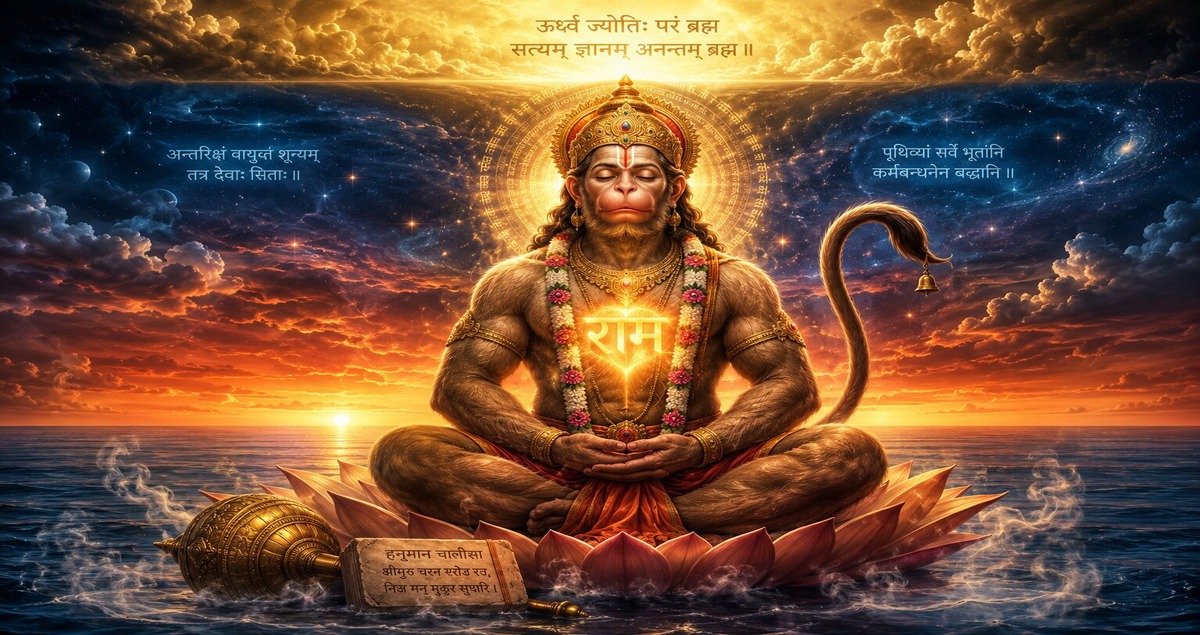
Discover the profound meaning of the first chaupai of Hanuman Chalisa, the importance of Ram naam, and why chanting Ram Ram transforms inner consciousness and daily life.
The Hanuman Chalisa is more than a devotional hymn; it is a spiritual compass that has guided millions toward inner strength, unshakable faith, and the realization that the divine name of Ram can dissolve every fear. When we truly grasp the meaning of Hanuman Chalisa, its forty chaupais stop being mere verses and start becoming a roadmap for the soul. At the very heart of this transformation lies the opening chaupai, which sets the entire tone of surrender, wisdom, and illumination. In this deep dive, we will unfold the first chaupai of Hanuman Chalisa, explore the profound importance of Ram name, and understand why the simple utterance Ram Ram holds the power to rewire a devotee’s consciousness.
Before we go any further, let the sacred sound settle in your mind. The first chaupai is:
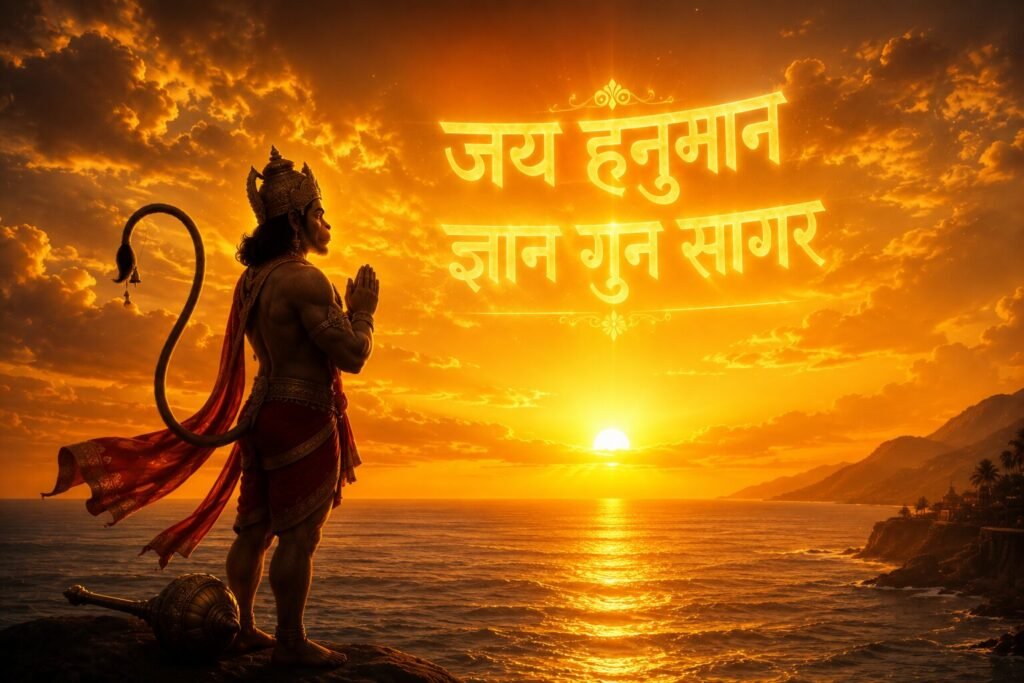
“Jai Hanuman gyan gun sagar,
Jai Kapis tihun lok ujagar.”
These two lines are not just a praise; they are a declaration of the awakened state that Hanuman embodies and that every seeker can eventually reach. Let’s decode this jewel word by word, soak in its spiritual vibration, and then connect it to the life‑changing energy of Ram’s name.
Word‑by‑Word Meaning of the First Chaupai
Understanding the literal meaning is the first step toward unlocking the deeper layers. The beauty of this chaupai is that even a surface translation reveals an ocean of wisdom.
- Jai – Victory, glory, or hail. It is an exclamation that acknowledges triumph over ignorance, ego, and darkness.
- Hanuman – The divine devotee, son of the Wind God, whose very essence is selfless service and power harnessed through devotion.
- Gyan – Knowledge. Not mere intellectual information, but the experiential wisdom that brings the soul closer to liberation.
- Gun – Virtues, qualities, or attributes. These are the divine traits like compassion, courage, humility, and unwavering focus.
- Sagar – Ocean. An endless, unfathomable reservoir that never dries up.
- Kapis – Lord of the monkeys. “Kapi” means monkey, and “Ish” means lord; together it refers to Hanuman as the king of the vanara race, symbolizing the mind that has been fully tamed.
- Tihun lok – The three worlds: physical, astral, and causal; or earth, heaven, and the netherworld.
- Ujagar – Illuminator, enlightener, one who brightens or makes radiantly famous.
A straightforward translation reads:
“Victory to Hanuman, who is an ocean of wisdom and virtues. Victory to the king of the monkeys, who illuminates all three worlds.”
At first glance, it sounds like a beautiful welcome. But when you sit with it, you realize Tulsidas wasn’t just writing a greeting—he was encoding the very formula of spiritual evolution.
The Deeper Spiritual Meaning of “Jai Hanuman Gyan Gun Sagar”
Why is Hanuman called an ocean of wisdom and virtue? An ocean is not a cup that can be emptied. It receives all rivers—clean and muddy alike—and yet remains vast, deep, and generous. Hanuman’s consciousness works the same way. The first chaupai of Hanuman Chalisa tells us that true knowledge is never dry. It flows together with gunas (divine qualities). Wisdom without virtue becomes arrogance; virtue without wisdom becomes blind ritual. Hanuman balances both seamlessly.
When we chant Jai Hanuman gyan gun sagar, we are not merely praising a deity outside of ourselves. We are invoking the inner Hanuman—the part of our being that already possesses limitless intelligence and the capacity for unconditional love. Every repetition waters that seed within us. The importance of Ram name becomes evident here because Hanuman himself declared that all his wisdom and virtue come from one source: the constant remembrance of Rama.
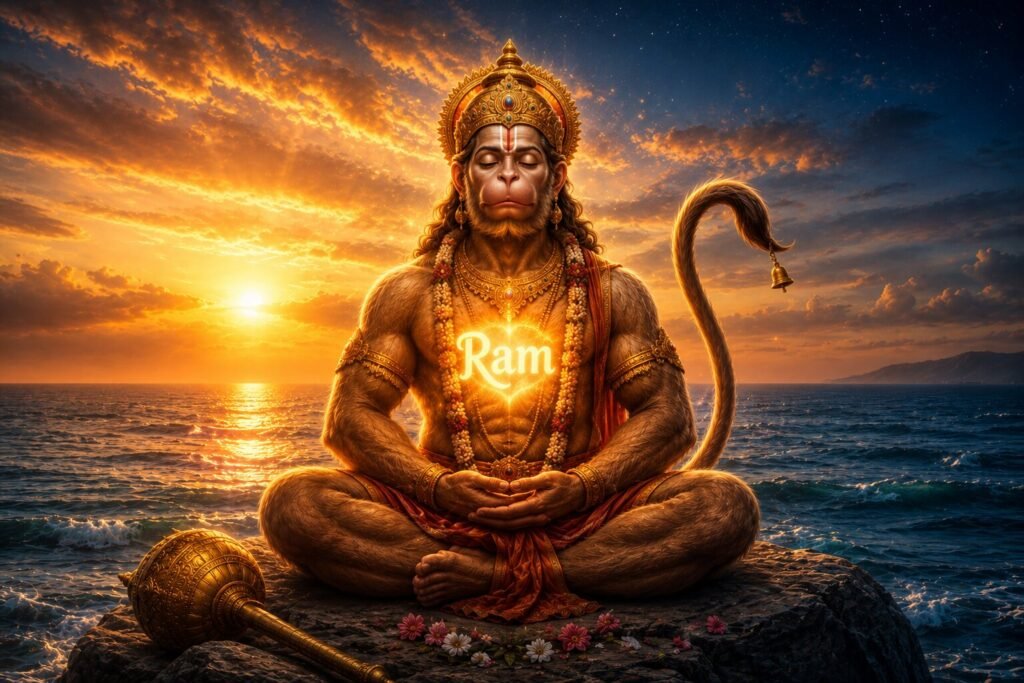
“Jai Kapis Tihun Lok Ujagar” – The Mind That Lights Up Existence
This line takes the praise from the personal to the cosmic. Hanuman is Kapis, the lord of the monkeys. In yogic symbolism, the monkey represents the restless mind—constantly jumping from branch to branch. A mind that has become Hanuman, however, is no longer distracted. It is fully focused, yet dynamic. Such a mind becomes an illuminator of the tihun lok, the three realms.
The three worlds are not just mythological geography. They represent:
- Bhuloka – The physical plane of waking experience.
- Bhuvarloka – The subtle astral plane of thoughts, emotions, and dreams.
- Svarloka – The causal plane of deep sleep and potential.
An awakened mind filled with Ram Ram remembrance brightens every layer of our existence. Our actions become aligned, our emotions become peaceful, and even our subconscious begins to radiate clarity. This is the inner meaning of ujagar. Tulsidas is telling us: master your mind through devotion, and you become a light that darkness cannot touch.
Why the First Chaupai Holds the Key to the Entire Hanuman Chalisa
Most people approach the Hanuman Chalisa as a collection of requests for protection and blessings. But the opening verse is neither a request nor a plea—it is pure acknowledgment. By starting with total acceptance of Hanuman’s divine stature, the devotee’s ego is instantly set aside. This is the secret to the meaning of Hanuman Chalisa as a complete spiritual practice: it begins where the ego ends.
When you genuinely accept that the same ocean of wisdom and virtue exists within your own soul (as a spark of Hanuman), the subsequent verses stop being petitions and become affirmations. Every chaupai after this one is built on the foundation of the first. Therefore, the first chaupai of Hanuman Chalisa is not merely an introduction; it is the lens through which the whole text must be read.
The Unshakeable Connection to the Importance of Ram Name
Now, we must ask: What filled Hanuman with such an ocean of wisdom that he could illuminate all three worlds? The answer is hidden in the vibration of Ram Ram that constantly flowed in his heart.
Throughout the Ramayana, Hanuman performs impossible feats—leaping across the ocean, carrying an entire mountain, burning Lanka with his tail, and comforting Sita in her darkest hour. Before every single act, he first takes the name of Ram. When asked about his astonishing strength, his simple reply is: “I am only a servant of Ram; it is His name that works through me.” This reveals the importance of Ram name as the ultimate catalyst of grace.
The name ‘Ram’ is not just a label for Lord Rama. It is a beej mantra, a seed syllable that carries the essence of the supreme being. ‘Ra’ represents the illuminating light of the soul, and ‘Ma’ represents the nurturing stillness within. Together, they bridge the individual with the infinite. Chanting Ram Ram tunes the devotee’s frequency to courage, righteousness, and unshakable peace.
The first chaupai of Hanuman Chalisa glorifies Hanuman, and Hanuman glorifies the name of Ram. Thus, the entire hymn becomes an elaborate worship of the divine name.
Ram Ram: A Mantra That Transforms Ordinary Life into Tapasya
In countless households across India and beyond, people greet each other with Ram Ram instead of a simple hello. On the surface, it is a cultural marker. In practice, it is a constant spiritual inoculation against negativity. Every utterance of Ram Ram is a mini‑meditation, a reset button that brings the mind back to its source.
When the first chaupai declares Hanuman as gyan gun sagar, it is giving you a glimpse of what a life steeped in Ram Ram can become. A person whose lips and heart repeat Ram’s name gradually accumulates gunas (virtues) and gyan (wisdom) without even trying, because the name does the cleansing. You do not need to swim across the ocean of the mind alone; the name becomes the boat, and Hanuman becomes the wind in your sails.
Practical Lessons from the First Chaupai for Daily Life
1. Embrace the Ocean Mindset
Hanuman’s wisdom is an ocean—non‑judgmental, all‑accepting, and profoundly calm. In your daily interactions, try to listen without immediately labeling something as good or bad. This small shift mirrors the sagar quality and prevents mental restlessness.
2. Let Virtue Lead Your Knowledge
It is tempting to accumulate information and call it wisdom. The first chaupai tells us that real gyan always travels with gun (virtue). Before sharing your knowledge, ask yourself: is it kind? Is it useful? Is it offered with humility? If yes, you are living the first chaupai of Hanuman Chalisa.
3. Illuminate the Three Worlds
Your bhuloka (body) needs right action, your bhuvarloka (mind) needs loving emotions, and your svarloka (deep inner space) needs silence. By chanting Ram Ram with awareness, you slowly bring light to all three. You will notice your sleep improves, your thoughts become optimistic, and your physical energy feels cleaner.
4. Use Ram Ram as a Breath Anchor
The importance of Ram name becomes most tangible when you synchronize it with your breathing. Inhale: silently say Ram. Exhale: again Ram. Within a few minutes, the mind stops its monkey-like jumping. You will taste what Kapis—the tamed monkey mind—actually feels like.
Stories That Bring the First Chaupai to Life
The oral tradition surrounding the Hanuman Chalisa is rich with stories that mirror the first chaupai’s message. One such tale recounts a time when Tulsidas himself was tormented by severe arm pain. Instead of asking Hanuman to take away the suffering, the saint wrote the verses that begin with “Jai Hanuman gyan gun sagar.” He acknowledged the ocean of wisdom first, and the pain dissolved in that vastness.
Another story comes from a simple farmer in rural India who could barely read but chanted Ram Ram while plowing his fields. Once, when a wild bull charged at him, he instinctively shouted “Jai Hanuman!” and the bull stopped in its tracks. Later, a sage explained, “Your constant repetition of Ram’s name had awakened the Hanuman within you; the bull sensed the tihun lok ujagar energy and could not attack.” True or symbolic, this story illustrates how the meaning of Hanuman Chalisa comes alive through uninterrupted remembrance.
Linking the First Chaupai with the Essence of Ram Bhakti
The Hanuman Chalisa is essentially a love song to the name of Ram. Every line after the first chaupai amplifies this truth. The verse “Ram duare tum rakhvare” tells us that Hanuman is the doorkeeper to Rama’s abode, and entry is impossible without his grace. And what is his grace? It is the awakening of unconditional Ram Ram remembrance within the devotee.
When you chant the first chaupai with full surrender, you are not just praising a distant deity. You are admitting: “I, too, wish to become an ocean of wisdom and light. I accept that this is possible only through the name of Ram, and I invite Hanuman’s presence to make it happen.” This synergy between devotee and deity is what makes the first chaupai of Hanuman Chalisa a complete sadhana in itself.
Why Chanting the First Chaupai Alone Can Shift Your Energy
Because we live in a world of information overload, the mind often feels like a stormy sea rather than a calm sagar. A beautiful practice is to isolate the first chaupai and chant it eleven times, either aloud or mentally, before beginning your day or meditation. The vibration of “Jai Hanuman gyan gun sagar” reorganizes the mental waves. The phrase “Jai Kapis tihun lok ujagar” expands your inner light outward, making you feel rooted yet boundless.
The immediate effect is a palpable sense of protection. But the long‑term effect—revealed by countless practitioners—is the spontaneous arising of Ram Ram in the heart. When the mind becomes an ocean of Hanuman’s qualities, it cannot help but reflect Ram’s name. This is the secret glory of the importance of Ram name: you do not need to struggle to chant it; it begins to chant itself within you.
Bringing It All Together: Living the First Chaupai
The meaning of Hanuman Chalisa ultimately insists that you are not separate from the divinity you worship. Hanuman is the perfected state of the human mind. By meditating on the first chaupai, you are planting a seed that grows into a tree of wisdom, whose fruit is the constant sweetness of Ram Ram.
Here is a closing affirmation you can use after your recitation:
“I am an ocean of wisdom and virtue, awakened by the grace of Hanuman. The name Ram is my breath. May I illuminate all the worlds with love, courage, and peace.”
This affirmation, born directly from the first chaupai of Hanuman Chalisa, is not a denial of your current struggles but a recognition of your true potential.
A Final Note on the Power of Simplicity
Tulsidas could have chosen complex Sanskrit meters, but he gave us the Hanuman Chalisa in simple Awadhi so that the common person could access these truths. The first chaupai is the grand invitation. When you chant it, do not rush toward the end. Linger on the word sagar and feel the vastness. Linger on ujagar and visualize your inner world lighting up. And then, softly, let the sound of Ram Ram complete the journey.
No matter where you are on your spiritual path, the first verse of the Hanuman Chalisa meets you with open arms, promising that the ocean you seek is already within you, waiting to be stirred by the wind of Ram’s name. So the next time you greet the day or a fellow traveler, let it be with the most powerful, ancient blessing: Ram Ram.
Leave a Reply