
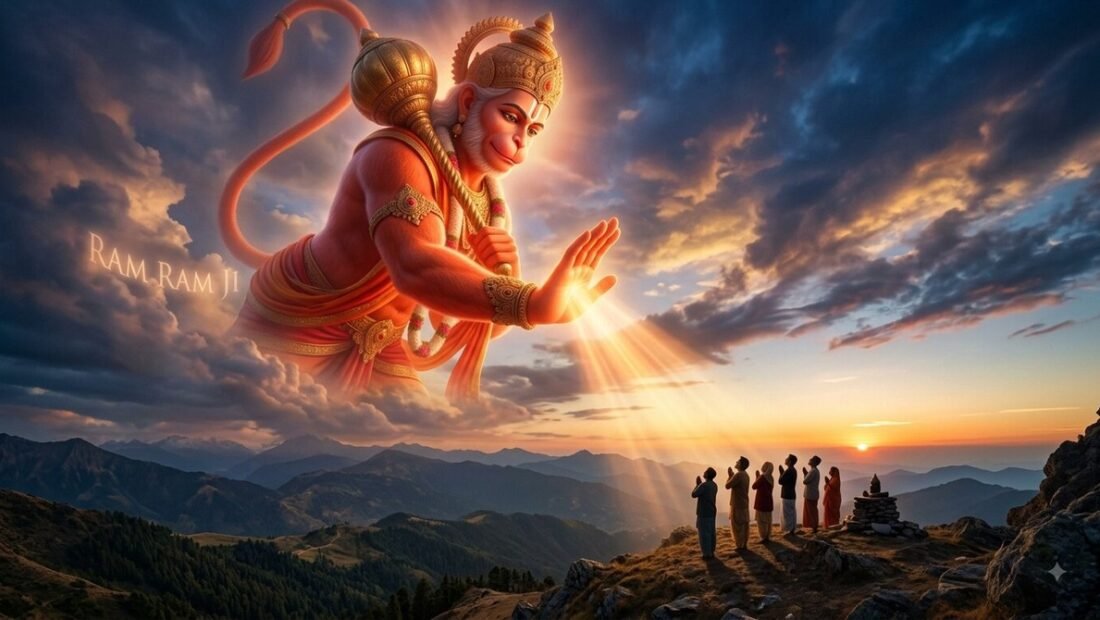
I remember the first time this line truly hit me. I wasn’t sitting in a temple or reading a scripture. I was stuck in traffic, anxious about a work deadline, my mind buzzing with a hundred worst-case scenarios. Out of nowhere, a faint audio of the Hanuman Chalisa drifted in from a nearby auto-rickshaw, and the words fell like a gentle thunderclap: Mahavir Vikram Bajrangi, Kumati Niwar Sumati Ke Sangi.
In that moment, it wasn’t just a chant. It was a direct conversation with my own chaotic mind. And I believe that’s exactly what Tulsidas intended.
Today, we’re going to sit with this one powerful chaupai. No rush. I want to share what it has taught me, what it can teach you, and how a simple line from the Hanuman Chalisa can become your anchor. If you’ve ever felt your thoughts spiralling out of control, if you’ve ever wished for a clear, calm, and devoted mind, you are in the right place.
Before we go deeper, it’s beautiful to see how the entire prayer sets the stage. The Hanuman Chalisa’s opening doha clears the path by first bowing to the guru and then to Hanuman’s essence as pure wisdom and strength. If you’ve not explored that foundation, I’d gently point you to a lovely piece on the significance of Hanuman Chalisa’s opening doha. Understanding where we begin makes the journey through each chaupai so much richer.
What Does “Mahavir Vikram Bajrangi” Really Mean?
Let’s break it down, word by word, as if we’re unwrapping a gift.
Mahavir means the great warrior, the supremely brave one. It’s not just physical courage. It’s the inner valor to cross the ocean of doubt, to burn the Lanka of ego, and to stand unshaken when life tests you. Hanuman didn’t just fight demons; he fought despair. And that’s what Mahavir represents for us.
Vikram translates to valour, but a very specific kind of valour — the one that flows from wisdom. It’s not reckless aggression. It’s the power that knows exactly when to be gentle and when to roar. When I chant Vikram, I’m not asking for muscles. I’m asking for the wisdom to act rightly, even when it’s hard.
Bajrangi is a name that paints a thousand pictures. It literally means the one whose body (anga) is as strong as a thunderbolt (bajra), the weapon of Indra. We all know the story: as a child, Hanuman mistook the sun for a ripe fruit and leapt to grab it. Indra hurled his thunderbolt, which struck Hanuman’s jaw, leaving it swollen and earning him the name “Hanuman”. But that strike also proved his indestructible nature. Bajrangi is the reminder that our true self, when aligned with the Divine, can absorb any shock.
But what’s the point of all this power?
Tulsidas answers instantly in the second half of the line.
Kumati Niwar Sumati Ke Sangi – The Heart of This Hanuman Chalisa Chaupai
This is where the magic happens.
Kumati Niwar – the one who removes ku-mati, the dark, unripe, or negative thought patterns. And Sumati Ke Sangi – the constant companion of su-mati, the bright, clear, and noble intelligence.
Think about it. Hanuman’s immense strength isn’t for showing off. It’s for clearing the inner garbage. He is the original mindfulness guru, but infinitely more compassionate.
I used to imagine Hanuman only as a divine superhero who lifts mountains and flies across oceans. And he is that. But the deeper Hanuman Chalisa meaning reveals him as the caretaker of our inner world. He is not just Ram Bhakt Hanuman Bajrangbali who serves Lord Rama externally. He is the devotion that serves the Rama within us by removing everything that blocks our vision.
Kumati can be anything: jealousy, fear, overthinking, judgment, the victim mentality, or even the subtle arrogance of “I know it all”. We’ve all been there. I know I have, just this morning, if I’m honest. Sumati is the clarity that replaces it — the ability to see people as they are, to respond instead of react, and to feel the presence of Ram in every situation.
How does he do it? By being our sangi — our companion. Not a distant judge, but a friend who walks with us.
When you chant this Hanuman Chalisa chaupai, imagine Hanuman sitting right inside your mind. Every dark, twisted thought that arises, he gently plucks it out like a weed. And in the empty space, he plants a seed of golden light.
He Removes the Clouds, Not Just the Rain
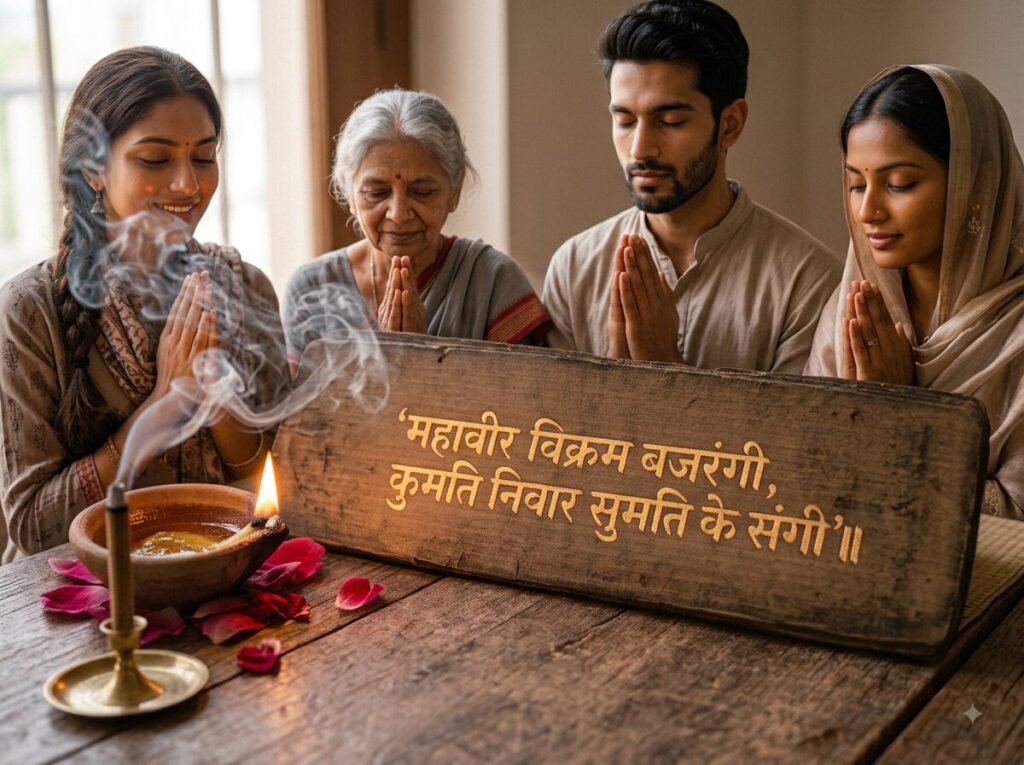
There is a beautiful subtlety here that I want you to notice. The chaupai doesn’t say “Kumati Nivarak” — the destroyer of negative thoughts. It says “Kumati Niwar” — the one who prevents them, who wards them off, who keeps them from taking root in the first place.
That is a promise of prevention, not just cure.
If we allow this Ram Bhakt Hanuman Bajrangbali to become our constant companion, we start noticing a shift. That trigger that used to send you into a spiral of anger suddenly loses its charge. You see it coming, but you don’t bite. You feel the kumati trying to enter, but you remember Sumati Ke Sangi, and somehow, the door to your mind is guarded by a mighty, gentle monkey.
We don’t become perfect overnight. But we gain an ally who is perfect. And perfection, when it walks with us, rubs off.
The Mahavir Vikram Bajrangi Meaning in Daily Life
Let’s bring this down to the kitchen sink and the office desk. What does the mahavir vikram bajrangi meaning look like on a Tuesday morning when the Wi-Fi is down and the kids are screaming?
It looks like remembering that your strength is not yours alone.
You are a Bajrangi too, in potential. Your body and mind, when infused with the remembrance of Ram, can become like a thunderbolt — not hard and unfeeling, but resilient and untouchable by petty negativity. The mahavir vikram bajrangi meaning is not about becoming a warrior with a mace; it’s about becoming a warrior of the heart who refuses to let unkindness rule their day.
When you greet someone with a silent Ram Ram Ji, you are invoking this very energy. You are shaking hands with the Sumati in them and inviting Sumati into your own space.
Why “Sumati Ke Sangi” Is More Than Just Intelligence
We often equate Sumati with intelligence or good sense. But in the Bhakti tradition, Sumati goes deeper. It is the intelligence that naturally gravitates toward Rama. The mind that finds joy in satsang, in service, in listening to the Ramayana. It is the intellect soaked in love.
You’ve experienced this. You know those moments when you hear a kirtan and tears flow without reason? That’s Sumati. When you wake up early without an alarm, not out of discipline but out of an eager longing to sit with your ishta deva? That’s Sumati.
And Hanuman is the Sangi, the eternal friend of such a mind. He doesn’t force you to be good. He accompanies you until goodness becomes your natural fragrance.
Connecting to Ram Rajya: The Ultimate Vision
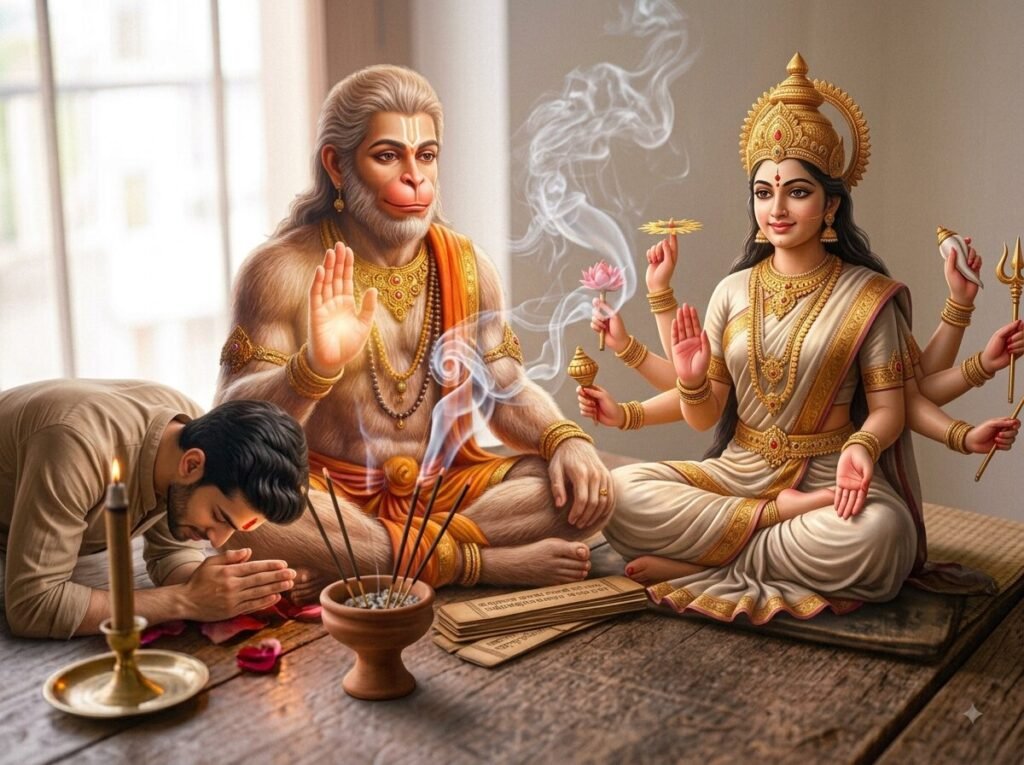
This cleaning of our inner world has a massive, practical outcome. When our individual mind is free of Kumati and filled with Sumati, we begin to create a mini Ram Rajya wherever we go.
In a wonderful exploration of what Ram Rajya really teaches us about living well, the idea of righteous living is framed not as a utopian dream, but as a daily practice of alignment. Hanuman is the architect of that practice within us. He builds the Ayodhya of our consciousness stone by stone, thought by thought. A Ram Rajya outside can only be built by people who have started building it inside. And Hanuman, the ultimate devotee, is the one who hands us the tools through this very chaupai.
It all connects. That’s the beauty of the Hanuman Chalisa meaning — every line supports the other, and all of it points toward a life of joyful service.
Ram Dut Atulit Bal Dhama: The Messenger’s Authority
You might wonder, what gives Hanuman the authority to clear our kumati? The answer lies in his identity as Rama’s messenger.
Tulsidas beautifully describes Hanuman as Ram Dut Atulit Bal Dhama, the messenger of Rama who is the abode of incomparable strength. A messenger acts on behalf of the one who sent him. Hanuman doesn’t operate on his own whims; he carries the full sanction of Lord Rama. So when he removes our negative thoughts, it’s not an act of a demigod imposing his will. It’s the loving grace of Rama himself, sent through his most trusted servant.
Understanding that Hanuman is Ram Dut changes the way we see his role in this chaupai. The strength of Bajrangi is not his own. It is Rama’s power flowing through him. The removal of kumati is not a personal favour; it is Rama’s promise of purification for all who seek refuge. I find that incredibly reassuring. It’s not up to me to fight every dark thought alone. The messenger has been deployed. I just need to invite him in.
A Simple Practice: Letting Hanuman Guard Your Mind
I want to share a small practice that has changed my inner landscape. You can try it too, starting right now.
Tonight, before you sleep, sit quietly for three minutes. Take the name Ram Ram Ji gently three times. Then, mentally recite the chaupai: Mahavir Vikram Bajrangi, Kumati Niwar Sumati Ke Sangi. As you say it, visualize your mind as a room. See Hanuman standing at the door, his palm raised in blessing. As each unnecessary worry, each heavy memory, each toxic comment from the day tries to enter that room, see him gently stopping it. Not with force, but with the simple authority of Rama’s name.
Then, ask him to bring Sumati. Just one quality of clear thinking that you need tomorrow. Maybe patience. Maybe focus. Maybe the ability to not interrupt when someone is speaking. Watch him smile and place that gift in your heart.
Do this for a week. And you’ll know, experientially, why he is Kumati Niwar Sumati Ke Sangi. It won’t be a theory anymore. It will be a relationship.
The Thunderbolt That Heals
I used to think spiritual growth was about adding things — more knowledge, more mantras, more rituals. But this chaupai taught me that it’s also, profoundly, about subtraction. The removal of Kumati.
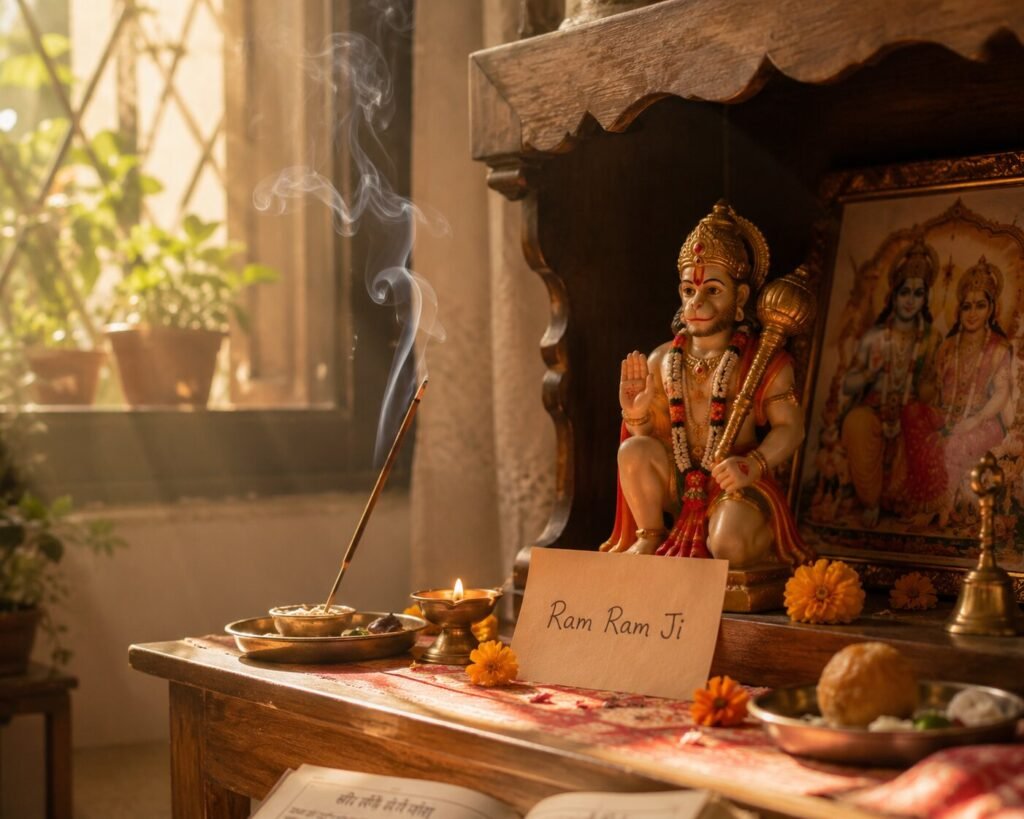
And who better to trust with that delicate surgery than the one whose very body is a thunderbolt? A thunderbolt can destroy, but in Hanuman’s case, it only destroys what is false. It never harms the essence of who you are. The mahavir vikram bajrangi meaning is not that of a weapon against you, but a shield for your soul.
Every time you chant this Hanuman Chalisa chaupai, you are undergoing a deep cleansing. You are saying, “I am willing to let go of my limited, clouded thinking. I am ready to be the companion of clarity, with Hanuman by my side.”
Walking Forward with Sumati
So, dear reader, wherever you are, whatever battle you’re fighting silently, know this: you are not alone. You have the Mahavir. You have the Vikram. You have the Bajrangi. And more importantly, you have the one who lovingly uproots your inner darkness and walks with you, hand in hand, into the light of good, devoted intelligence.
Let’s end where we often begin, with the simplest and deepest name: Ram Ram Ji.
Keep it on your lips. Keep Hanuman in your heart. And watch how Kumati fades, not with a fight, but with the gentle, thunderous grace of the one who is forever Sumati Ke Sangi.
Ram Ram Ji.