
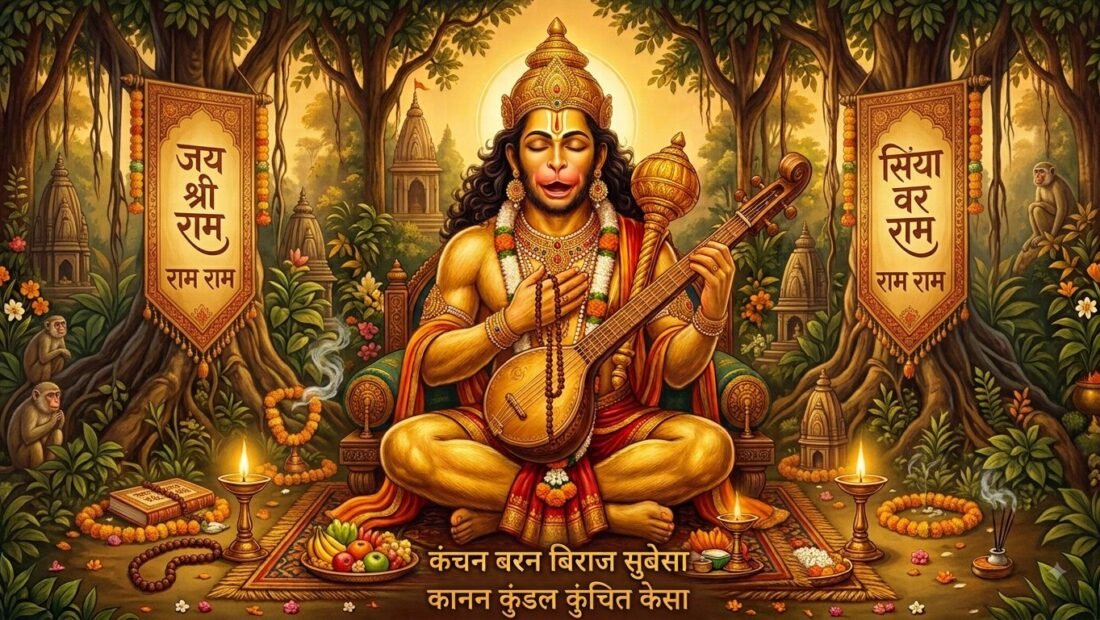
I have always found that some verses don’t just speak to the mind—they paint a picture directly on the heart. And this one chaupai of the Hanuman Chalisa does exactly that. You don’t just hear it. You see it. You feel a golden warmth spread behind your closed eyes, and suddenly, you are standing in the presence of the most beautiful being you can imagine.
The line is Kanchan Baran Biraj Subesa, Kanan Kundal Kunchit Kesa.
If you’ve ever wondered what the handsome, majestic side of Hanuman looks like—not just the fierce warrior, not just the humble servant, but the utterly resplendent lord of grace—this is the verse. This is where Tulsidas gives us darshan of the Ram Bhakt Hanuman as a radiant prince of devotion. Today, I want to sit with you and unwrap this luminous chaupai, word by golden word.
It’s helpful to remember where we are in the prayer. The Hanuman Chalisa’s opening doha clears the mirror of our heart, and the chaupais that follow begin revealing Hanuman’s endless qualities. If you’ve explored that gateway before, you know it sets a profound foundation for verses like this one. (You can read more about the significance of Hanuman Chalisa’s opening doha to see how beautifully the stage is set.) Right before this, we heard of his thunderbolt body and his role as the remover of dark thoughts. And now, Tulsidas zooms in and shows us what that remover of darkness actually looks like when you behold him face to face.
And oh, what a vision it is.
The Words Unfolded: A Simple Meaning
Let’s begin with a simple, heartfelt translation. Kanchan Baran means one whose body (baran) is like gold (kanchan). Biraj Subesa means seated or adorned in beautiful garments, fine attire. Kanan Kundal refers to the radiant earrings (kundal) worn on his ears (kanan). And Kunchit Kesa describes his hair (kesa) – curled, wavy, beautifully twisted.
So the whole line becomes: “He whose complexion is golden, who is clad in divine, beautiful garments, whose ears shine with brilliant earrings, and whose hair is curly and dark.”
It’s a description of breathtaking beauty. But as with all things in the Hanuman Chalisa, the outer form is a doorway. The real gold is inside. The hanuman chalisa meaning in english here is that Hanuman embodies the refined, luminous quality of a mind that has been completely purified by the name of Rama. His golden skin isn’t just a cosmetic detail. It’s the glow of perfect sumati.
Kanchan Baran – A Body of Pure Gold
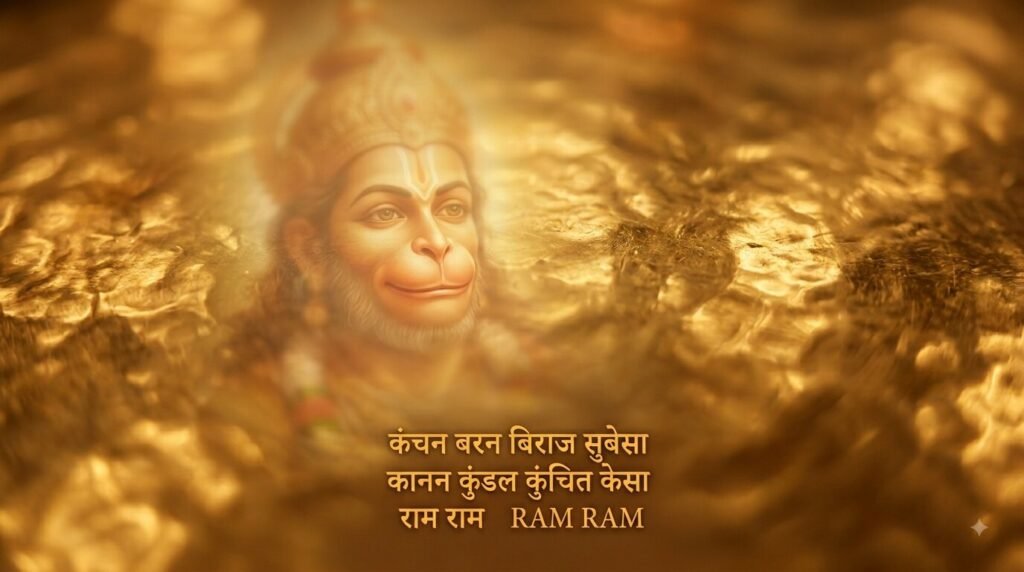
Gold. We all know it. We all have some relationship with it. But why does Tulsidas, a saint who had renounced worldly treasures, choose to describe Hanuman’s body as molten gold? Because in the spiritual vocabulary of India, gold represents purity, incorruptibility, and the highest value. Gold doesn’t tarnish. It doesn’t rust. Fire doesn’t destroy it; it only makes it brighter.
Hanuman’s form is kanchan baran because he has passed through the fire of complete surrender. His body is not flesh and bone the way we experience ours. It is a body made of Ram Naam. Every cell vibrates with the Ram Ram mantra. When you see him in meditation, the golden hue is the first thing that strikes you. It’s as if the morning sun has decided to take a form and sit in front of you.
I like to imagine him like that. Not as a distant idol, but as a living, breathing golden presence. And you know what that golden light does? It gently pushes away the shadows inside us.
Biraj Subesa – Adorned in Divine Garments
Hanuman doesn’t sit naked like an ascetic who has renounced the world. He wears biraj subesa – exquisite clothes, silks, ornaments, the attire of a celestial being. This is so important. It tells us something fundamental about bhakti.
Bhakti is not a rejection of beauty. It is the celebration of beauty at its most sacred. Hanuman is the ultimate servant, but he is also a king’s devotee. He serves Lord Rama, the very embodiment of majesty and grace. His appearance reflects the dignity of the one he loves. When you are deeply in love with God, your entire being becomes beautiful. You carry yourself with a quiet elegance.
For us, this is an invitation to honour our own bodies and our own space. It doesn’t mean wearing expensive clothes. It means keeping your body, your room, your altar – everything – with such care that it feels like a temple. That’s the spirit of biraj subesa. You are dressing your life in devotion.
Kanan Kundal – The Earrings That Hear Our Prayers
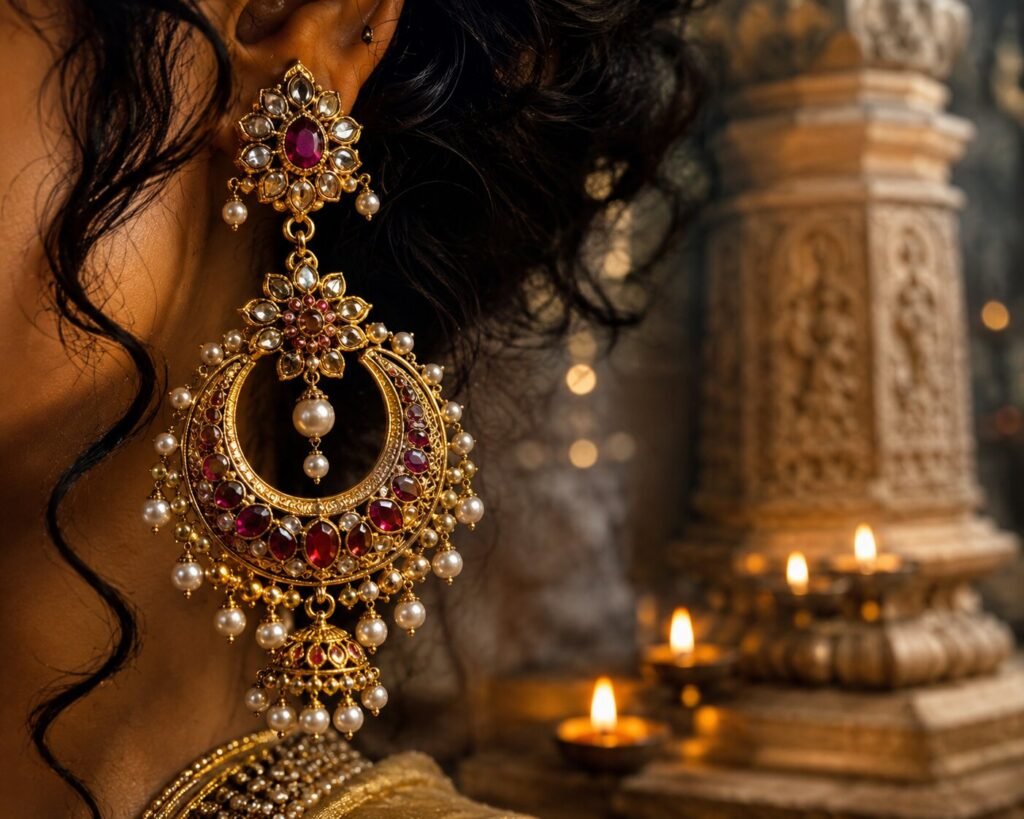
Now the image becomes even more detailed. Tulsidas notices the earrings. Kanan Kundal. Brilliant gold rings adorning the ears. And why earrings? Because ears are for hearing.
I find this so tender. Hanuman, the Kanchan Baran Biraj Subesa one, is not just a magnificent form to be worshipped from afar. He wears kundals so that he can hear you. Every whisper. Every silent cry. Every time you chant the ram ram mantra quietly under your breath, those golden ears are tuned in. He doesn’t miss a single syllable of your heart’s calling.
His identity as Ram Dut Atulit Bal Dhama, the messenger of Rama with incomparable strength, gives him the authority to receive our prayers and carry them directly to the Lord. (You can dive into that title’s profound meaning here: Ram Dut Atulit Bal Dhama.) The earrings symbolize his eternal alertness. He is never distracted. He is never too busy. He wears the ornaments of a perfect listener.
Sometimes, when I’m sharing something painful in prayer, I picture those earrings catching the light. And I feel heard.
Kunchit Kesa – The Curls of Unbound Devotion
And then the hair. Kunchit Kesa. Dark, curling locks framing that golden face.
Curls are wild. They cannot be tamed. They move with the wind, they fall over the forehead, they have a life of their own. Tulsidas might have chosen to describe straight, orderly hair. But he chose kunchit – curled, twisted, abundant. I believe this is a beautiful symbol.
Hanuman’s devotion is not stiff or formal. It is free, organic, playful, and completely natural. His curly hair is the physical expression of a love that cannot be contained. It bursts forth like a spring. It refuses to be straightened into dogma.
The dark hair against the golden skin is also visually stunning. The contrast reminds us that in the divine, all dualities meet. Light and dark, strength and softness, warrior and child – all coexist. Hanuman’s kunchit kesa invites us to let our own devotion be a little wild, a little unbound, not always perfectly neat. Love is messy and beautiful, and so is his hair.
The Deeper Hanuman Chalisa Meaning in English
So, here we are. We’ve painted a picture together with words. But what is the fruit of this meditation?
The deeper hanuman chalisa meaning in english for this chaupai is an invitation to beautify your inner world. When you consistently chant the ram ram mantra, something changes in your energetic field. Your thoughts become less jagged. Your presence becomes more calming. Over time, you start radiating a subtle light. People may not know why they feel good around you, but they do. You are, in your own tiny way, becoming kanchan baran.
This is not ego. This is the natural result of associating with Sumati. When Hanuman sits in your heart, he slowly dresses your soul in biraj subesa. He hangs the earrings of attentive listening on your ears so you become a better friend, a better partner, a better human. He curls your straight, rigid thinking into the soft waves of acceptance and joy.
And when enough of us begin to embody even a fraction of this golden form, the world outside starts resembling something else entirely. It begins to reflect what Ram Rajya truly teaches us about living well – a kingdom where righteousness, beauty, and compassion are the very air we breathe. (You can explore that vision here: what Ram Rajya teaches us about living well.)
A Simple Practice: Gazing at the Golden Form
I want to offer you a small, silent practice. It requires nothing but a few minutes and your imagination.
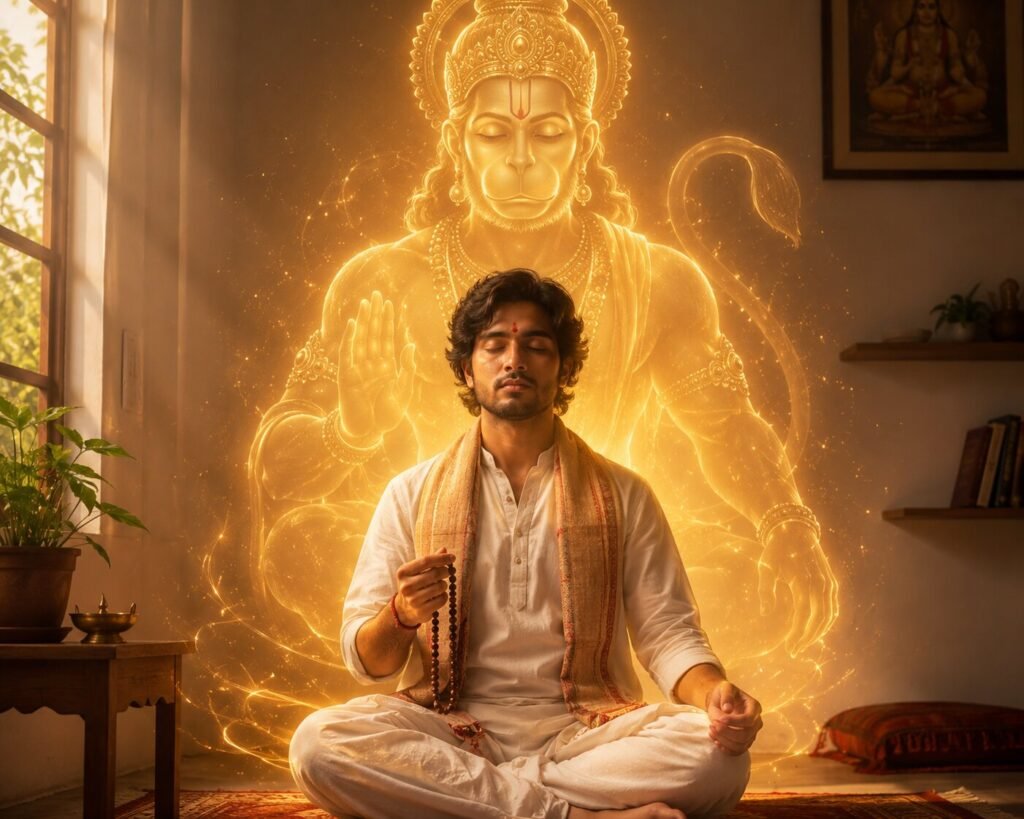
Sit comfortably. Close your eyes. Chant Ram Ram softly three times. Now, bring the image of Hanuman to your mind’s eye. But don’t think of the murti you usually see. Instead, build this specific picture: his body glowing like a sunrise made of pure gold. He is seated gracefully, dressed in fine, shining cloth. His earrings catch a celestial light and sparkle gently. His dark, curly hair falls softly around his neck and shoulders. He is looking at you with a faint, reassuring smile.
Just hold that image. If your mind wanders, come back to the golden light on his face. Do this for two minutes. And then, gently open your eyes.
What you are doing is planting a seed of sumati. You are letting the Kanchan Baran Biraj Subesa form wash over your kumati. And it works. I’ve done it in moments of anxiety, and the gold seems to melt away the gray.
The Beauty That Saves
We usually think of Hanuman as a saviour through strength – the mountain lifter, the demon slayer, the terror of Lanka. But here, Tulsidas shows us another side. Hanuman also saves us through sheer beauty. The kind of beauty that makes you want to be a better person. The kind of beauty that makes sin unappealing, not because it’s forbidden, but because it looks so dull compared to the gold of his presence.
When I find myself slipping into old, ugly patterns of thought, I try to recall this chaupai. “Kanchan baran biraj subesa…” and the ugliness inside me feels embarrassed. Not shamed. Just gently shown the door by something infinitely more attractive. That is the power of sacred aesthetics. The ram ram mantra is beautiful. So is the one who carries it in his every breath.
Walking as Kanchan Baran
We started with a description of Hanuman. But let’s end with you and me.
We are not Bajrangi. We may not have thunderbolt strength yet. But we can have a little gold. A little curl of wild, joyful love. A pair of internal earrings that help us truly listen to our loved ones. We can dress our soul in biraj subesa by surrounding ourselves with sacred sounds, sacred images, and sacred company.
The kanchan baran biraj subesa, kanan kundal kunchit kesa chaupai is a mirror. It shows us what we are becoming, drop by golden drop, in the company of Hanuman. It gives us permission to be beautiful in our devotion – not in a flashy, worldly way, but in the deep, quiet way that makes a person glow from within.
So today, as you go about your day, whisper Ram Ram softly. And if you catch a glimpse of sunlight glinting off something golden – a piece of jewellery, a rim of a frame, the evening sun on a window – let it remind you of Hanuman’s form. Let it remind you that you are slowly being transformed into gold.
Ram Ram Ji.
[…] the verse before this one — Kanchan Baran Biraj Subesa — is explored in beautiful detail in this dedicated post. Reading them together gives you the full portrait, top to […]