

There is a line in the Hanuman Chalisa that I keep returning to, again and again, whenever life feels a little heavier than usual. It goes:
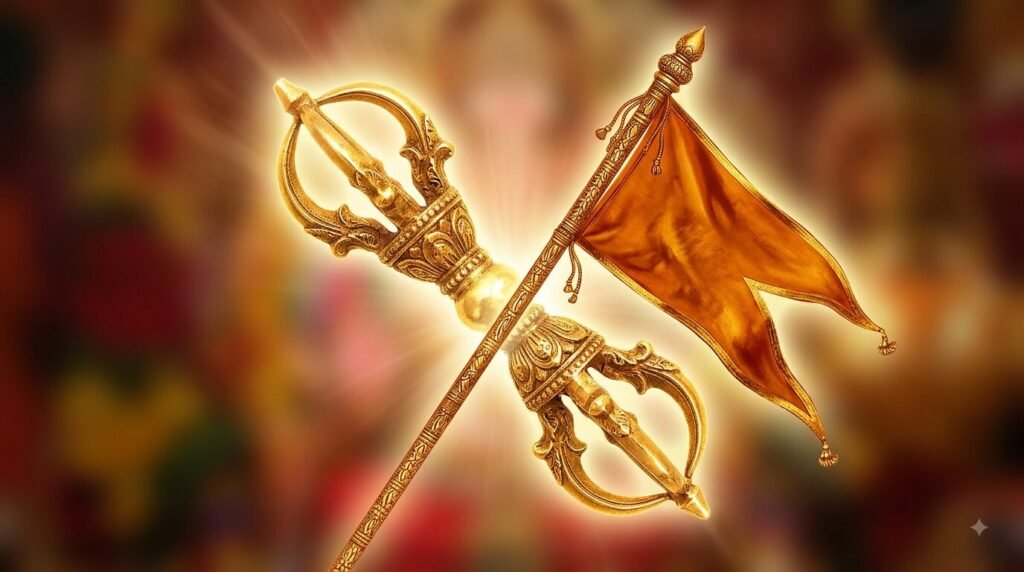
हाथ बज्र औ ध्वजा बिराजै। काँधे मूँज जनेऊ साजै॥ “Haath bajra au dhwja viraje, kandhe munj janeu saje.”
I remember the first time someone actually explained this verse to me. I was sitting in a small temple courtyard, the kind where the floor is still warm from the afternoon sun, and an old priest smiled and said, “You recite it every day, but do you see it?” That question changed how I read the whole prayer. And that is exactly what I want to do with you here — not just translate the words, but help you see them.
Shri Hanuman Chalisa Meaning: Why This One Line Matters
Before we open up this specific verse, let me place it for you. The Hanuman Chalisa, composed by the great poet-saint Goswami Tulsidas in the Awadhi language, is a devotional hymn of forty verses (chalis means forty) praising Lord Hanuman. Each chaupai is a little doorway. Some describe his golden form, some his devotion to Shri Ram, and some — like this fifth one — describe the divine symbols he carries on his body.
The full Shri Hanuman Chalisa meaning is layered. On the surface it is praise. Underneath, it is a map of qualities that a devotee is quietly invited to absorb: courage, humility, discipline, and unshakable faith. When Tulsidas describes what Hanuman holds and wears, he is not merely painting a picture. He is handing us a mirror.
This fifth chaupai comes right after the description of Hanuman’s radiant golden complexion and his beautiful attire. If you’d like to revisit that earlier imagery, the verse before this one — Kanchan Baran Biraj Subesa — is explored in beautiful detail in this dedicated post. Reading them together gives you the full portrait, top to bottom.

Meaning of Hath Bajra aur Dhwja Viraje: The Mace and the Flag
Now let us slow down and actually taste each word. The meaning of Hath Bajra aur Dhwja Viraje unfolds in two powerful images, so let me take them one at a time.
Haath means hand. Bajra (from the Sanskrit vajra) is the thunderbolt — the same weapon associated with Indra, king of the gods. It is a symbol of absolute, unbreakable strength. And dhwja means the flag or banner. Biraje (from virajate) means “adorns” or “shines gracefully.” So the line tells us that in Hanuman’s hands shine the vajra and the sacred banner.
Why does this matter so deeply? The vajra is not just a weapon; in our tradition it represents a mind and spirit that cannot be broken. Diamonds are called vajra in Sanskrit for the same reason — nothing cuts through them. When you meditate on Hanuman holding the vajra, you are being reminded that devotion, when it is sincere, becomes indestructible. The obstacles come, yes, but they shatter against faith rather than the other way around.
The dhwja, the flag, carries an entirely different flavor of meaning. A raised banner is a declaration. It says, without a single word, “This is where I stand, and this is whose I am.” Hanuman’s flag is a flag of victory — but not the loud, boastful kind. It is the quiet victory of a heart that has surrendered completely to Shri Ram. I find that image endlessly moving. He does not carry the flag for himself. He carries it for his Lord.
There is a beautiful teaching hidden here for you and me. We all carry something in our hands every day — our work, our worries, our phones, our responsibilities. The verse gently asks: what banner are you raising with your life? What are you declaring, day after day, through your choices? Hanuman’s answer is clear, and it invites us to make our own answer just as clear.
Kandhe Munj Janeu Saje: The Sacred Thread of the Scholar-Devotee
The second half of the chaupai — kandhe munj janeu saje — is where I feel the verse becomes tender and personal.
Kandhe means shoulders. Munj refers to a particular sacred grass (munja grass) traditionally used to make the yajnopavita, and janeu is that sacred thread itself, worn across the shoulder and torso. Saje means “adorns beautifully.” So Hanuman wears the sacred thread of munj grass gracefully upon his shoulder.
This single detail tells us something enormous about who Hanuman is. The janeu is the mark of a learned one, a Brahmin, a person committed to knowledge, discipline, and spiritual duty. Tulsidas is reminding us that Hanuman is not merely mighty — he is wise. He is a scholar. He knows the scriptures, the grammar, the deeper truths. Strength without wisdom is dangerous; wisdom without strength is often powerless. In Hanuman, the two live together in perfect harmony.
I love that the poet placed the vajra and the janeu in the very same verse. On one shoulder, the raw power to move mountains. Across the same body, the humble thread of the disciplined student. That combination is the whole spiritual ideal in miniature. Be strong enough to protect, wise enough to serve, and humble enough to bow.
When you understand this, the entire tone of the Chalisa shifts. You stop seeing Hanuman as only a warrior and start seeing him as a complete being — the perfect bhakta, the ideal servant, the model for how we might carry our own gifts.
Ram Ram Chanting Health Benefits: When Sound Becomes Medicine
Now I want to turn to something that surprises a lot of people, and it connects directly to why devotees recite verses like this one aloud, day after day. The Ram Ram chanting health benefits are not merely a matter of belief — many of them are now discussed in the language of the body and the nervous system, too.
Let me be honest and careful here: I am sharing spiritual and traditional understanding, not medical prescription. If you are dealing with a health condition, please talk to a qualified doctor. But within that honest boundary, there is a lot worth exploring.
When you chant Ram Ram slowly and rhythmically, a few things tend to happen. Your breathing naturally lengthens and steadies. Rhythmic chanting encourages long, controlled exhalations, and long exhalations are one of the simplest ways to gently activate the calming, “rest and digest” side of the nervous system. Many people who chant regularly describe a settling of anxious thoughts, a slower heartbeat, and a kind of warmth spreading through the chest.
The repetition itself does something too. When the mind is given one simple, sacred sound to hold, it stops sprinting in a hundred directions. That mental quieting is why chanting has been used across cultures as a doorway into meditation. You are not forcing the mind to be still; you are giving it a gentle place to rest.
Then there is the emotional layer, which I think matters most of all. The name Ram is, for millions, a name of comfort. Mahatma Gandhi is famously said to have taken the name of Ram on his lips in his final moment. There is a reason the name shows up at births, at deaths, and at every hard passage in between. Chanting it can create a felt sense of not being alone — a companionship with the divine that soothes in a way no external medicine quite reaches.
So when a devotee recites the Hanuman Chalisa, complete with this fifth chaupai, they are not only worshipping. They are, in a very real and embodied way, giving themselves a daily practice of breath, focus, and emotional steadiness. The spiritual and the physical are quietly holding hands.

How to Bring This Chaupai Into Your Own Daily Life
Understanding a verse is one thing. Living it is another. So let me offer you a few simple, grounded ways to carry the spirit of Haath bajra au dhwja viraje, kandhe munj janeu saje into your everyday.
First, recite it slowly and with attention, not as a race to the fortieth verse. When you reach this line, pause for even two seconds and picture the vajra in Hanuman’s hand. Let that image quietly remind you that your own resolve today can be unbreakable.
Second, treat the janeu image as a call to keep learning. Read a little, reflect a little, grow a little each day. Hanuman was a scholar as much as a hero, and you honor him more by staying curious than by anything else.
Third, and this is the one I hold closest, ask yourself Hanuman’s question each morning: whose flag am I raising today? Not literally, of course, but in spirit. What am I declaring with my hours, my kindness, my patience? When we live deliberately, our ordinary day itself becomes a kind of banner.
Connecting the Threads: The Chalisa as One Living Whole
One thing I have learned is that no single verse of the Hanuman Chalisa stands entirely alone. They breathe together. This fifth chaupai gains its full weight only when you feel the verses around it.
If you want to trace the journey from the very beginning, the first chaupai and the power of Ram Naam is the perfect place to start, because it sets the devotional foundation everything else rests upon. And the deeper you go into these teachings, the more you see how the values in the Chalisa echo the timeless family and moral traditions captured in verses like Raghukul Reet Sada Chali Aayi — the idea that a promise, once given, is kept no matter the cost. That same steadfastness is exactly what Hanuman embodies.
Reading these together, you begin to notice a single golden thread running through all of it: strength in service of love, and love expressed as loyalty. That is the heartbeat of the whole tradition.
A Few Honest Reflections Before We Close
I want to end gently. I am not asking you to believe anything you are not ready to believe. What I am inviting you to do is sit with this one verse a little longer than you normally would.
We live in a world that rewards speed and noise. And here is Tulsidas, five hundred years ago, describing a mighty being whose greatest quality is not his power but his devotion. The vajra could conquer anything, and yet Hanuman uses his strength to serve. That inversion — power bending itself in humility — is, I think, the most radical and beautiful idea in the entire hymn.
So the next time you recite Haath bajra au dhwja viraje, kandhe munj janeu saje, let it be more than words on your lips. Let it be a small, daily promise to yourself: to grow strong without becoming hard, to stay humble without becoming small, and to raise, through your own life, a quiet flag of love.
जय श्री राम। जय हनुमान।
If you’d like to know more about the person behind these reflections, do visit our About Us page. And your trust matters to us — you can always read our Privacy Policy to understand exactly how we care for your information.
Frequently Asked Questions
What is the meaning of Hath Bajra aur Dhwja Viraje?
It means that the vajra (thunderbolt mace) and the victory banner shine gracefully in Lord Hanuman’s hands, symbolizing unbreakable strength and devotion to Shri Ram.
Why does Hanuman wear the janeu (sacred thread)?
The munj-grass janeu across his shoulder marks him as a learned, disciplined scholar-devotee, showing that his might is always paired with wisdom.
Are there real benefits to chanting Ram Ram?
Many devotees experience calmer breathing, reduced stress, and emotional comfort through rhythmic chanting. These are traditional and experiential benefits, not a substitute for medical care.