

Say “Jai Shri Ram” anywhere in India and you’ll see heads turn with recognition, not confusion. Lord Ram isn’t just a figure from ancient scripture — he’s a working template for how to lead, how to stay loyal, and how to hold onto honor when everything around you is falling apart. That’s a strange thing to say about a king who lived thousands of years ago, but the Ramayana wasn’t written as a history lesson. It was written as a manual for character, and it still gets read that way today.
This piece looks at what makes Lord Ram’s example so durable, why the phrase “Jai Shri Ram” carries the weight it does, and — since so many people planning a spiritual journey ask about it — how the two ends of Ram’s story on Indian soil, Ayodhya and Rameswaram, connect geographically. If you’re researching Ram’s life for personal reflection, a school project, or an actual pilgrimage, you’ll find practical answers here, not just devotional language.
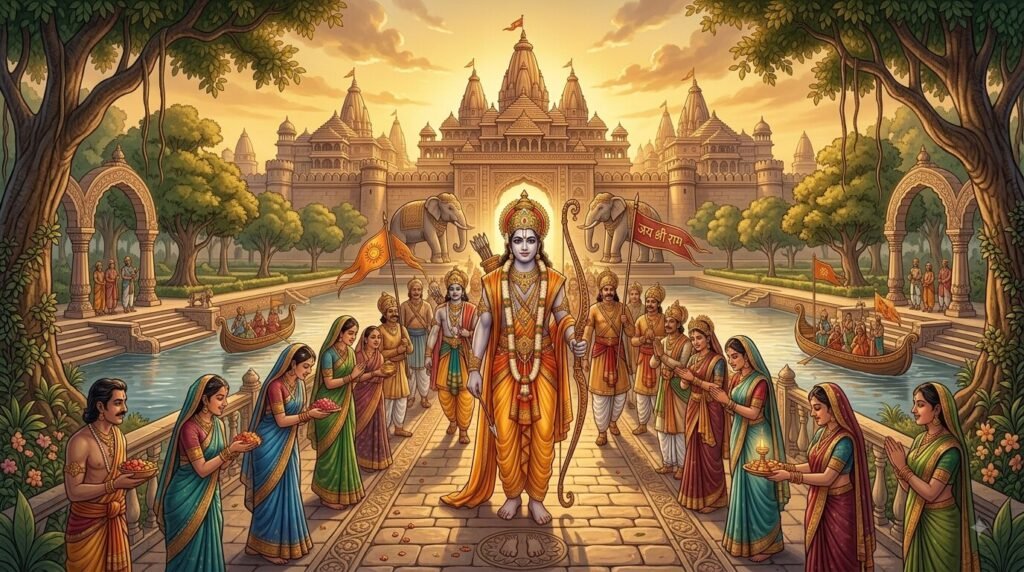
Who Was Lord Ram, and Why Does His Story Still Matter?
Ram was the crown prince of Ayodhya, son of King Dasharatha, and — according to Hindu tradition — the seventh avatar of Vishnu. But reducing him to a royal title misses the point. What made him significant wasn’t his birthright. It was what he did when that birthright was taken away.
On the eve of his coronation, Ram was exiled to the forest for fourteen years because of a promise his father had made to his stepmother, Kaikeyi. A lesser person would have fought it, negotiated it, or at least resented it publicly. Ram didn’t. He accepted the exile without bitterness, took his wife Sita and brother Lakshman with him, and walked away from a throne without looking back.
That single decision is where the “Rama Principle” really begins. It’s not about winning. It’s about choosing what’s right even when it costs you everything you were promised.
Leadership Lessons From Lord Ram
Leading Without a Title
For most of the Ramayana, Ram has no formal power. He’s not a king. He’s a forest-dwelling exile with a bow and a small group of loyal companions. And yet he leads — an army of vanaras, a coalition against Ravana, and eventually a kingdom he never manipulated his way into.
This matters for anyone thinking about leadership today. Authority on paper and actual leadership are two different things. Ram commanded respect through consistency: he did what he said, protected the people around him, and never asked others to take risks he wasn’t willing to take himself.
Decisions Made for the Collective, Not the Self
Ram’s choices repeatedly favored the group over his own comfort. Building the Ram Setu bridge to Lanka wasn’t a solo mission — it involved an entire army of vanaras, each contributing according to their ability, down to a small squirrel that helped by carrying pebbles. Ram noticed that contribution and honored it. Good leaders, the story suggests, see effort at every scale, not just the grand gestures.
Staying Calm Under Pressure
Sita’s abduction, the war with Ravana, the loss of allies in battle — none of it broke Ram’s composure in the way the epic tells it. He grieved, certainly, but he didn’t let grief stop him from making sound decisions. That distinction between feeling something fully and still functioning is one modern leadership training talks about constantly, usually without realizing it’s describing an old idea.
Loyalty in the Ramayana: What It Actually Looks Like
Loyalty gets thrown around loosely these days, often meaning nothing more than “doesn’t disagree with me.” The Ramayana shows a much sturdier version of it.
- Lakshman gave up palace comforts to follow Ram into exile, asking nothing in return and staying by his side through years of hardship.
- Hanuman searched an unfamiliar land for Sita, crossed an ocean, and later became the model devotee — a devotion so total that the opening doha of the Hanuman Chalisa begins by invoking exactly this quality before anything else is said about him.
- Sita herself showed a fierce, unwavering commitment to dharma even while held captive, refusing to compromise her values under pressure from Ravana.
- Bharata, Ram’s half-brother, ruled Ayodhya in Ram’s name for fourteen years but placed Ram’s sandals on the throne rather than claim it as his own.
None of these were passive relationships. Each person acted, sometimes at real personal cost, because they believed in what Ram stood for. That’s a useful distinction: loyalty in the Ramayana isn’t submission. It’s alignment with a shared value system.
If you want to sit with this idea a little longer, the fifth chaupai of the Hanuman Chalisa — “Hath Bajra Aur Dhwaja Biraje” — describes Hanuman standing ready with his mace and banner, and it’s worth reading for how it frames strength as something held in service of another, not for its own sake.
Living With Honor: Dharma as a Daily Practice
The word “dharma” gets translated as duty, righteousness, or cosmic order, and honestly none of those translations fully capture it. Dharma in the Ramayana is closer to “doing the right thing according to your role, even when it’s inconvenient.”
Ram is often called Maryada Purushottam — the ideal man who never crossed the boundaries of righteous conduct. He honored his father’s word even when it exiled him. He honored his role as a husband while also holding to his responsibilities as a king. He honored an enemy’s death by ensuring Ravana received proper funeral rites, recognizing his scholarship even in defeat.
That last point is worth sitting with. Honor, in this story, isn’t reserved for people who deserve it by our standards. It’s a discipline you maintain regardless of who’s on the other side.
Why “Jai Shri Ram” Carries So Much Weight
“Jai Shri Ram” translates roughly to “victory to Lord Ram,” and it’s one of the most widely used devotional chants in Hindu practice. You’ll hear it at temples, during Ramnavami celebrations, in daily greetings between devotees, and as an expression of faith during difficult moments.
The phrase isn’t just a slogan. For many, it’s shorthand for everything discussed above — a reminder to act with the same integrity Ram showed, even in small daily decisions. It shows up in bhajans, in wall art, in the names people give their children, and increasingly, in public life and political discourse as well. That last use has made the phrase a subject of broader conversation in India, separate from its devotional roots, though its original meaning remains rooted in reverence and faith.
If you’re looking for visuals to go along with your daily prayers or WhatsApp status, this collection of Ram Ram Ji images and divine Shri Ram photos has a range of options worth browsing.
Ayodhya to Rameswaram: Tracing Ram’s Journey on the Map
For devotees planning a pilgrimage, Ayodhya and Rameswaram represent the two bookends of Ram’s story — birth at one end, and the crossing into Lanka at the other. A lot of people search for the exact distance between them before planning a trip, so here’s what that looks like practically.

Ayodhya Ram Mandir distance to Rameswaram: The road distance between Ayodhya and Rameswaram runs roughly 2,400 to 2,600 km, depending on the exact route taken, and driving it non-stop would take well over two days. Most travelers don’t attempt this by car for that reason.
By train: There’s a dedicated weekly service, the Rameswaram–Ayodhya Cantt Shraddha Setu Express, that connects the two directly. It covers close to 2,900 km and takes around 52 to 53 hours one way, running through multiple states and major pilgrimage stops along the way. It’s a popular option for devotees who want to trace Ram’s route in one continuous journey rather than booking separate legs.
By air: Flying is far faster but requires a connection — typically through a hub city — since there’s no direct flight route between the two. Total travel time by air, including layovers, usually comes to somewhere around half a day.
Why Rameswaram Matters in Ram’s Story
Rameswaram isn’t just a random southern town with a temple attached. According to the Ramayana, this is where Ram worshipped Lord Shiva to seek forgiveness before crossing into Lanka to rescue Sita, and it’s traditionally linked to the starting point of the Ram Setu — the chain of shoals believed to be the remains of the bridge built to cross the strait. The Ramanathaswamy Temple here is one of the twelve Jyotirlinga shrines and also part of the Char Dham pilgrimage circuit, which is part of why it draws such steady footfall from devotees year-round.
Together, Ayodhya and Rameswaram form a kind of pilgrimage arc — one marking where the story began, the other marking a turning point near its climax. Many devotees plan their travel to cover both, sometimes as part of a longer circuit that includes other Ramayana-linked sites like Chitrakoot, Nashik, and Hampi.
Applying the Rama Principle Today
None of this has to stay confined to scripture study. A few practical takeaways carry over cleanly into ordinary life:
- Keep your word, especially when it’s costly. Ram’s exile is the clearest example — a promise honored even when honoring it meant losing everything.
- Lead by consistency, not authority. Titles fade. Reliability builds actual trust.
- Recognize effort at every level. The squirrel helping build the Ram Setu is a small detail with a big point — contribution matters regardless of scale.
- Hold to your values under pressure, not just when it’s easy. Sita’s steadiness in captivity and Ram’s composure in battle both illustrate this.
- Extend honor even to opponents. Ravana’s funeral rites are a reminder that respect doesn’t have to depend on agreement.
If you’d like to bring some of this into your own space at home, our shop has a small selection of devotional items connected to these themes.
Frequently Asked Questions
Who is Lord Ram in Hindu tradition?
Lord Ram is regarded as the seventh avatar of Vishnu and the central figure of the Ramayana. He’s revered as an ideal king, husband, and son, and is often referred to as Maryada Purushottam — the perfect embodiment of righteous conduct.
What does “Jai Shri Ram” mean?
It translates to “victory to Lord Ram” and is used as a devotional greeting, a chant during worship, and an expression of faith among Hindus, particularly during festivals like Ramnavami.
What is the distance between Ayodhya and the Rameswaram temple?
Road distance is approximately 2,400–2,600 km depending on the route. A direct weekly train, the Shraddha Setu Express, covers around 2,900 km in roughly 52–53 hours. Flying requires a layover and takes significantly less total time.
Is there a direct flight from Ayodhya to Rameswaram?
No direct flight currently connects the two cities. Travelers typically fly into a hub airport and take a connecting flight, or combine air travel with a road or rail leg for the final stretch.
Why is Rameswaram significant in the Ramayana?
It’s traditionally identified as the point from which Ram and his army built the Ram Setu to cross into Lanka, and the site where he worshipped Shiva before the battle to rescue Sita. The Ramanathaswamy Temple there is one of the twelve Jyotirlinga shrines.
What is the best time to visit Ayodhya and Rameswaram for a pilgrimage?
Ayodhya sees the biggest devotional crowds during Ramnavami (typically March–April) and Diwali. Rameswaram’s climate is warm year-round, but October to March is generally more comfortable for temple visits and coastal travel.
What does Maryada Purushottam mean?
It means “the ideal man who upholds the boundaries of righteous conduct.” It’s a title specifically associated with Ram, recognizing his consistent adherence to dharma across every role he held — son, husband, king, and warrior.
Can Ayodhya and Rameswaram be visited on one pilgrimage trip?
Yes, though it requires planning given the distance. Many pilgrims combine both into a longer Ramayana circuit, sometimes adding stops like Chitrakoot, Nashik, or Hampi, and typically travel by a mix of train and air rather than attempting the full route by road.
Conclusion
Lord Ram’s story endures because it doesn’t ask for blind devotion — it offers a working example of how to hold onto integrity when circumstances make that hard. Whether you’re drawn to the leadership lessons, the loyalty shown by those around him, or the physical pilgrimage connecting Ayodhya to Rameswaram, the throughline is the same: honor isn’t a one-time decision, it’s a daily practice. That’s the real weight behind every “Jai Shri Ram” spoken with intention rather than habit.
This article is written for devotional and educational purposes. Please see our disclaimer for more information on how content on this site should be interpreted.
[…] instruction about how a seeker should live, think, and surrender. The values it holds up — the balance of leadership, loyalty, and honor found throughout the Rama tradition — run beneath every […]