
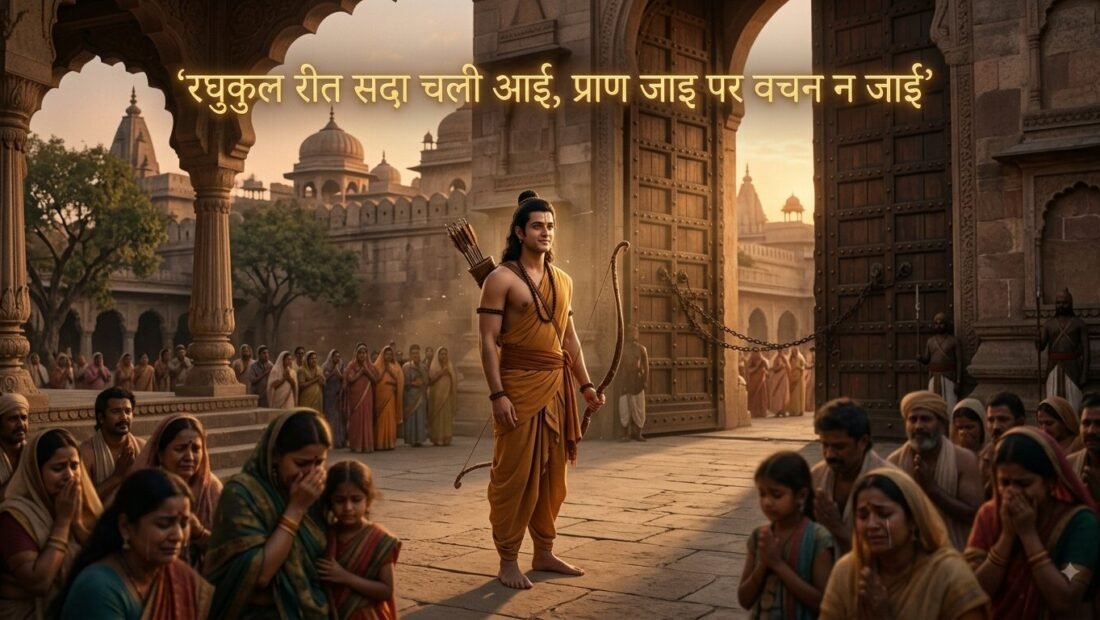
I want to take you to a moment that has echoed through centuries. A moment so quiet, yet so thunderous in its moral weight, that simply remembering it can straighten your spine and soften your heart at the same time.
It happens in the Ramcharitmanas, in the Ayodhya Kand. King Dasharatha has just been bound by his own promise to Kaikeyi. Rama, the beloved prince, the heartbeat of Ayodhya, must leave for the forest for fourteen years. And when Rama hears this, he doesn’t flinch. He doesn’t argue. He smiles, and he speaks a line that holds the entire soul of the Raghu dynasty within it.
This is arguably the most famous ramcharitmanas famous chaupai on integrity ever composed. The words are:
Raghukul Reet Sada Chali Aayi, Pran Jai Par Vachan Na Jai.
The tradition of the Raghu dynasty has always been this: life may go, but a given word never breaks.
Today, I want to sit with you and feel this verse. Not just understand it, but let it challenge us, comfort us, and call us higher. Because this single raghukul reet sada chali aayi chaupai might just be the most radical statement of integrity you ever bring into your daily life.
1. The Unshakable Moment That Gave Us This Ramcharitmanas Famous Chaupai
Let’s set the scene.
Dasharatha is shattered. The emperor, who had once been the mightiest of kings, is now a broken father, begging his son not to go. The queens are weeping. The citizens are preparing to follow their Rama into the wilderness. The entire palace trembles with grief and disbelief.
And in the middle of this storm, Rama stands like a lotus on a still lake.
He doesn’t see himself as a victim of Kaikeyi’s ambition. He doesn’t see himself as a son betrayed by a stepmother. He sees only one thing: his father’s word. Dasharatha had promised Kaikeyi two boons. That word, once given, is no longer his own. It belongs to the cosmos now. And Rama, being a true scion of the Raghu lineage, will not allow even a hair’s breadth of distance between his father’s word and the action that honours it.
So he speaks this ramcharitmanas famous chaupai. Calmly. Lovingly. Incomparably firm.
This is not blind obedience. This is a reverence for truth that has been woven into the very fabric of his being. And it’s an invitation for us to examine what our own fabric is made of.
2. Decoding “Raghukul Reet Sada Chali Aayi” — The Unbroken Tradition of Truth
Let’s break this raghukul reet sada chali aayi phrase down with the care it deserves. Raghukul means the dynasty of Raghu, the solar line of kings known for their righteousness. Reet means tradition, custom, the unbroken way of living that defines a family across generations. Sada chali aayi — this tradition has always, without exception, been upheld.
This is not a rule written in a law book and enforced by fear. It is a living, breathing heritage. The Raghus don’t keep their word because they are forced to. They keep it because the thought of not keeping it simply does not exist for them. It would be like asking the sun not to rise.
I find this deeply moving. And deeply humbling. How many of our so-called values are just preferences that we abandon the moment they cost us something? The raghukul reet sada chali aayi principle is not a preference. It is identity itself. Rama would sooner stop being Rama than break a promise.
And that brings us to the second half of this precious ramcharitmanas famous chaupai.
3. “Pran Jai Par Vachan Na Jai” — Life May Go, Word Never
This is the razor’s edge of the verse. Pran means life, the vital breath. Jai means may go, may leave. Par means but. Vachan means word, promise. Na jai — does not go, is not broken.
Life is the most precious thing we have. We cling to it. We fear its loss above almost everything. And Tulsidas places it on one side of the scale, and a spoken promise on the other. The promise weighs more.
Now, we need to be careful here. This is not a call to recklessly throw away one’s life for trivial words. It’s a call to recognize the sacred, almost terrifying power of speech. When we give our word, we are creating a reality. We are binding our soul to an action. The raghukul reet sada chali aayi teaching reveals that this bond is so sacred that even death cannot be an excuse to dissolve it.
For Rama, this was not an abstract ideal. He was about to walk into a forest filled with unknown dangers, for fourteen years, giving up a kingdom that was rightfully his. The cost was enormous. And yet, the smile never left his face. Because when your inner world is aligned with truth, outer loss feels strangely weightless.
4. A Lineage of Truth-Tellers Behind This Famous Chaupai
The beauty of the Ramcharitmanas is that Rama doesn’t claim to have invented this principle. He humbly says, “This is the reet that has always come down to us.” He stands on the shoulders of his ancestors, and every one of them adds weight to this ramcharitmanas famous chaupai.
King Raghu, after whom the dynasty is named, was famous for his generosity and truthfulness. He gave away everything he had, keeping nothing for himself, because a word spoken to a seeker was more valuable than his own comfort. King Dileep served a cow for days to honour a promise. King Aja remained steadfast in dharma even in the face of personal tragedy. And then there was Harishchandra, whose very name has become synonymous with truth. He gave away his kingdom, sold his family, and worked at a cremation ground — all to keep his word.
Rama belonged to this family. He carried their legacy not as a burden, but as a fragrance. Every time we hear Raghukul Reet Sada Chali Aayi, we’re being reminded that we, too, belong to a lineage. Maybe not a royal one. But every human being who has ever chosen truth over convenience has contributed to an invisible dynasty of integrity. We can choose to join it. This is the living heart of the ramcharitmanas famous chaupai.
5. How This Ramcharitmanas Famous Chaupai Speaks to Our Everyday Lives
You might be thinking, this is beautiful, but I’m not a prince about to be exiled. I’m a regular person with a messy life.
And I understand. But let me gently ask you: how many small promises have you broken this week? Not the big ones, but the tiny ones. Telling a friend “I’ll call you back” and then forgetting. Telling your child “we’ll play later” and then getting busy. Telling yourself “I’ll wake up early and do my sadhana” and then hitting snooze.
These little deaths of the word accumulate. They create a subtle, background static of unreliability inside our own consciousness. We stop trusting ourselves. And if we don’t trust ourselves, how can we trust the Divine?
The teaching of this ramcharitmanas famous chaupai is not that we must all be perfect Raghus overnight. It’s that we must begin to treat our word as sacred, starting with the smallest things. If you say you’ll do it, do it. If you can’t do it, don’t say it. Every kept promise is a brick in the Ayodhya of your character. Every broken promise is a crack in the foundation.
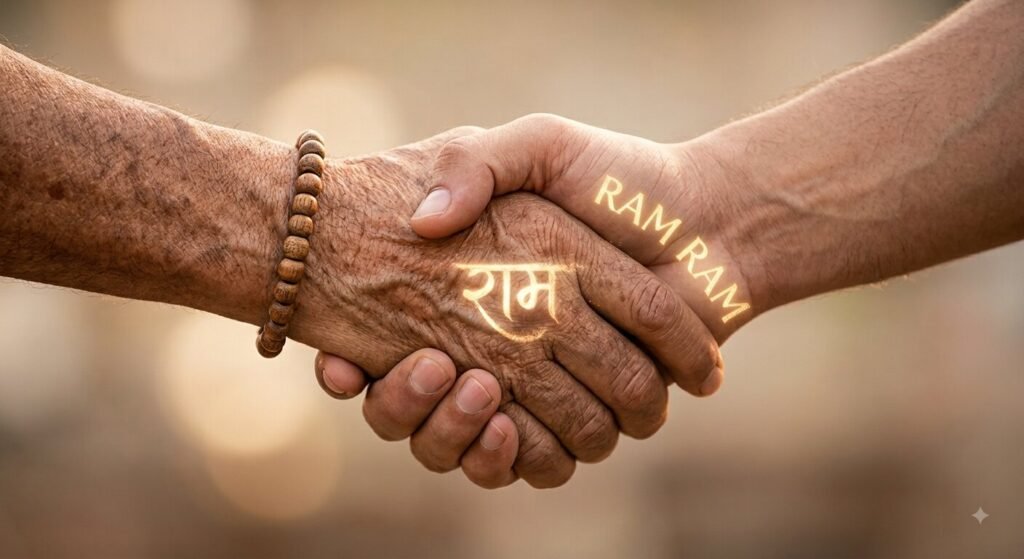
And here’s the secret: when you start keeping your small promises, the Ram Ram mantra becomes easier to chant with a full heart. Because Ram represents truth. You cannot truly call out to the embodiment of truth while living a life of convenient falsehoods. The vibration won’t match. But when your vachan becomes steady, your Ram Naam becomes a roar, not a whisper.
6. The Deeper Meaning of This Famous Chaupai in English
Let’s pause and reflect on the deeper significance that this ramcharitmanas famous chaupai unlocks. The Ramcharitmanas isn’t just a biography of a prince. It’s a map of the human soul’s journey back to its divine source. Every character, every event, every dialogue carries a spiritual symbol.
Here, Dasharatha represents the mind that has made a binding commitment (to the senses, to past karma). Kaikeyi represents the desire that manipulates that commitment for its own gain. And Rama is the awakened consciousness that, instead of fighting the mind or resenting the desire, simply honours the highest principle — truth — and walks gracefully into the forest of sadhana.
The forest is not a punishment. It’s the path of tapasya. By honouring his father’s word, Rama transforms exile into pilgrimage. This is the ultimate freedom. Not freedom from difficult circumstances, but freedom through unwavering integrity right in the middle of them.
I think about this often. When life feels unfair, when I’m asked to pay a debt I didn’t personally incur, this raghukul reet sada chali aayi verse reminds me that resentment is optional. I can stand in the nobility of keeping my inner word to walk the path of dharma, even when it’s hard. And that very stance turns my forest into a temple.
7. Hanuman — The Living Embodiment of Raghukul Reet Sada Chali Aayi
It’s impossible to speak of Rama’s truth without seeing it reflected perfectly in his messenger. Hanuman, the Ram Dut Atulit Bal Dhama, carries the raghukul reet sada chali aayi principle in his very being. His entire existence is about delivering Rama’s message faithfully, without alteration, without delay, and without ego.
When Hanuman went to Lanka, he didn’t just deliver a message. He became the message. He stood in the court of the demon king and spoke Rama’s words with such fearless integrity that even Ravana, the embodiment of arrogance, was momentarily shaken. Hanuman’s word was Rama’s word. There was no gap. And that is why he is the abode of incomparable strength. (I’ve explored that title’s profound meaning here: meaning of Ram Dut Atulit Bal Dhama.)
Hanuman shows us what happens when a being completely absorbs the spirit of this ramcharitmanas famous chaupai. He becomes invincible. Not because he can’t be hurt, but because his commitment to truth places him beyond the reach of falsehood. When you and I align our small words with the great Word, we too touch that strength.
8. A Simple Practice to Honour the Word, Inspired by This Chaupai
I’d love to share a small, gentle practice that this ramcharitmanas famous chaupai has inspired in my own life. It has nothing to do with grand oaths, and everything to do with returning to integrity, breath by breath.
Start your morning with this. Before you check your phone, before tea, before anything, place your hand on your heart and speak one promise to yourself. Something small and doable. “Today, I will speak only the truth.” Or, “Today, I will keep the promise I made to my body to walk for ten minutes.” Or, “I will not interrupt anyone today.”
Then, chant Ram Ram softly three times. Feel the sound seal the promise. During the day, whenever you remember, mentally chant Ram Ram again as a check-in. “Am I still aligned with my word?” If you slipped, don’t despair. Rama’s smile is big enough to hold your failures too. Just renew the promise and move forward.
This simple practice, over weeks, begins to rewire the mind. You become someone you can count on. And that inner reliability becomes a solid platform from which devotion can soar.
9. Building Ram Rajya One Promise at a Time
We often imagine Ram Rajya as a golden kingdom that existed once and will come again. And perhaps it will. But the wisdom of the Ramcharitmanas is far more immediate than a future utopia. Ram Rajya begins inside a person who keeps their word. It begins with the spirit of raghukul reet sada chali aayi.
Imagine a neighbourhood where everyone’s yes is yes, and their no is no. Imagine a workplace where commitments are honoured. Imagine a marriage where each partner trusts the other’s word completely. That is Ram Rajya, breaking into the present moment. I’ve written about how we can embody that vision in what Ram Rajya really teaches us about living well, and it all starts right here, with this one chaupai.
You and I may not rule a kingdom, but we rule our own small circle. Our family, our friends, our team at work. When we start practising the lesson of this ramcharitmanas famous chaupai in that circle, the kingdom of Rama stops being a myth. It becomes a lived reality, radiating outwards from every kept promise.
10. The Word That Carries the Word
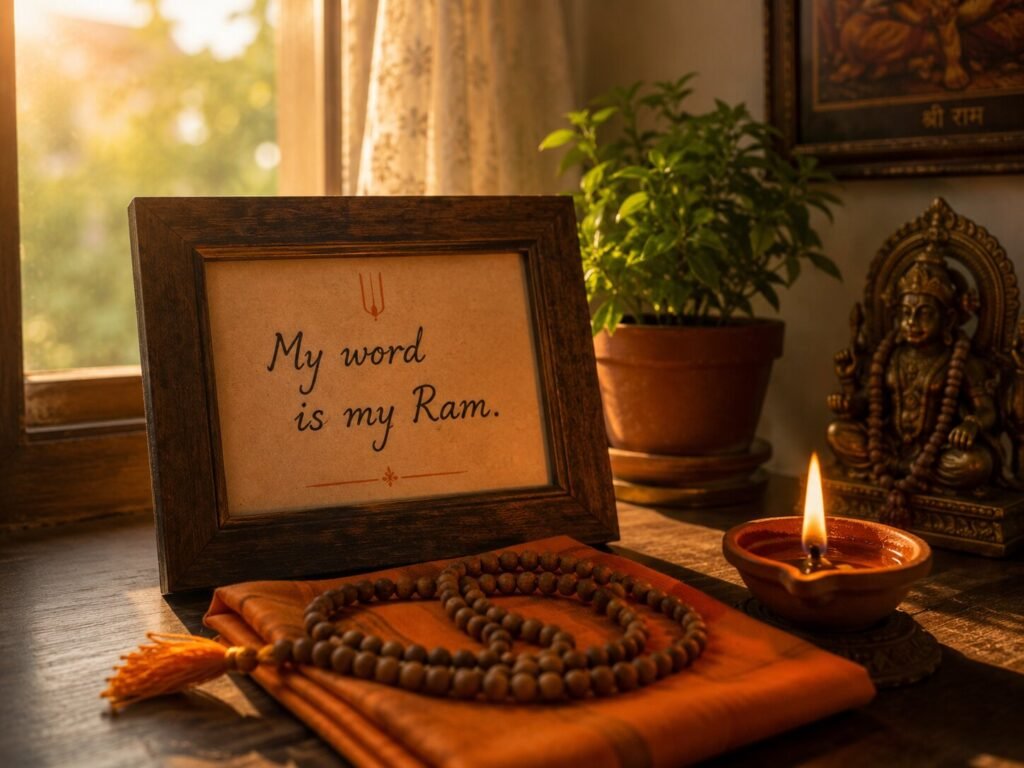
At the very foundation of all this is the mantra. Ram Ram. It’s not just a chant. It’s the ultimate vachan. The name of the Lord is the Lord Himself. When we say “Ram Ram”, we are entering into the lineage of truth-speakers. We are claiming our place in a family where pran may go, but vachan never.
The beautiful irony is that when you start living by this raghukul reet sada chali aayi verse, you stop needing to make grand promises. Your simple “yes” or “no” becomes enough. People feel it. They sense the solidity in you. And that solidity is nothing but Rama, settling gently into your bones.
Walking Into Our Own Forest
So, dear reader, as I finish writing this, I’m thinking of you. Wherever you are. Whatever forest life is asking you to walk into right now. Maybe it’s a difficult conversation you’ve been avoiding. Maybe it’s a commitment to your sadhana that you keep breaking. Maybe it’s a relationship where your word needs to become trustworthy again.
The forest is waiting. But so is Rama, standing just at its edge, looking back at you with that calm, unshakeable smile. He’s not telling you to be fearless. He’s telling you that the only thing worth fearing is a broken word. Once you know that, everything else, even exile, can feel like home.
Walk into your forest with your head held high. Let your yes be yes. Let your word be gold. And let every Ram Ram that leaves your lips be not just a chant, but a declaration that you have chosen to belong to the lineage of Raghukul.
Raghukul Reet Sada Chali Aayi, Pran Jai Par Vachan Na Jai.
May this ramcharitmanas famous chaupai take root in your heart, and may your life become its living proof.
Ram Ram Ji.
[…] how the values in the Chalisa echo the timeless family and moral traditions captured in verses like Raghukul Reet Sada Chali Aayi — the idea that a promise, once given, is kept no matter the cost. That same steadfastness is […]