

The Sacred Beginning — Why the First Doha of Hanuman Chalisa Matters
Every great spiritual journey begins with a single, conscious step. In the Hanuman Chalisa, that first step is not a call to battle, not a declaration of power — it is an act of profound humility. Before Sant Goswami Tulsidas praises the might of Lord Hanuman, before he recounts the victories of Shri Ram, he pauses. He bows. He cleans.
This is the genius, the grace, and the spiritual depth embedded in the very first Doha of the Hanuman Chalisa.
The Hanuman Chalisa is a 42-verse composition structured to glorify Lord Hanuman’s divine qualities while serving as a practical spiritual tool for meditation and devotion. It opens with two Dohas — short rhyming couplets — before flowing into the famous 40 Chaupais (quatrains). These two introductory Dohas carry the entire philosophical weight of the composition on their shoulders. This article dives deep into the first Doha, unpacking every word, every metaphor, and every hidden teaching to help you recite it with true understanding rather than mere habit. Skillastro

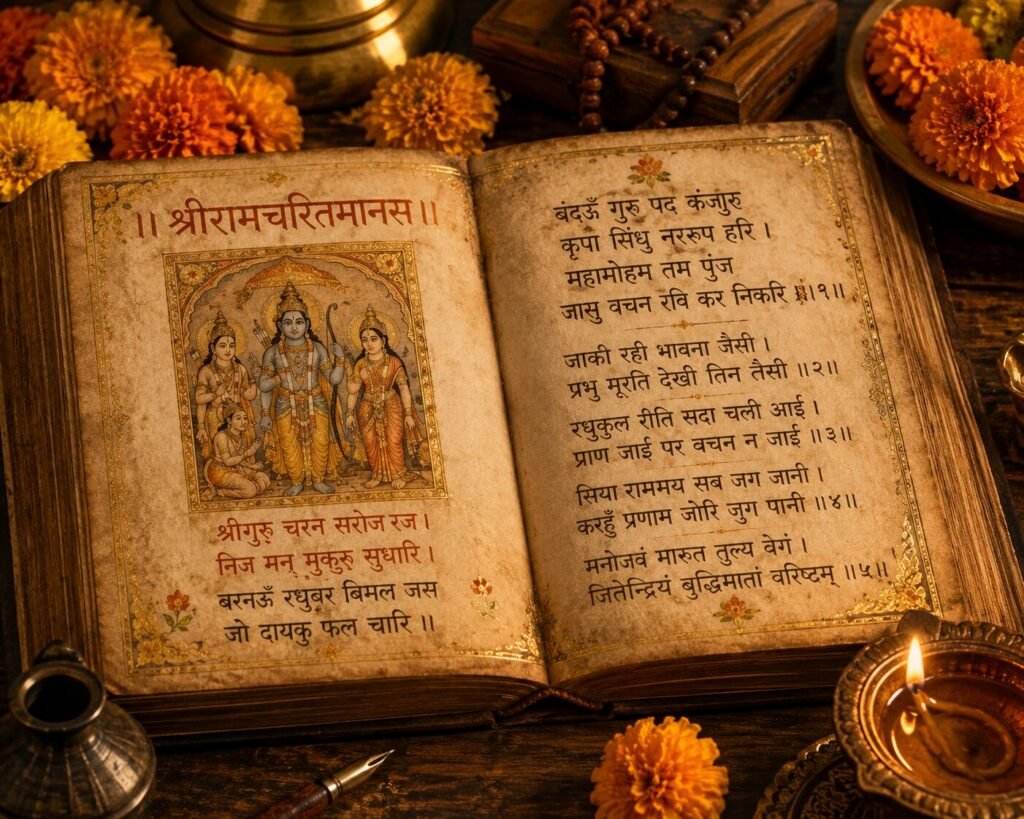
The First Doha — Original Text
In Devanagari:
श्रीगुरु चरन सरोज रज, निजमन मुकुरु सुधारि।
बरनउँ रघुबर बिमल जसु, जो दायक फल चारि॥
In Roman transliteration:
Shri Guru Charan Saroj Raj, Nij Manu Mukuru Sudhāri।
Baranau Raghubar Bimal Jasu, Jo Dāyaku Phala Chāri॥
This translates to: “With the dust of my Guru’s lotus feet, I cleanse my heart’s mirror and sing the pure glory of Lord Rama, which bestows the four fruits of life: righteousness, wealth, pleasure, and liberation.” Sanskrit Mantras
In just two lines, Tulsidas has established an entire spiritual worldview. Every single word in this Doha is a doorway into a vast room of wisdom. Let us walk through each one.
Word-by-Word Breakdown of the First Doha
1. Shri (श्री)
The word “Shri” is not merely an honorific prefix. In Sanskrit, Shri refers to the divine feminine principle of auspiciousness, abundance, and grace — associated with Goddess Lakshmi. When Tulsidas begins with Shri, he is not just saying “respected.” He is invoking the highest auspiciousness right at the threshold of his composition. He is saying: let everything that follows be touched by divine grace. It is a prayer embedded in a single syllable.
2. Guru (गुरु)
The word Guru comes from two Sanskrit syllables: Gu (darkness/ignorance) and Ru (remover). A Guru is, literally, the one who removes darkness. Tulsidas’s spiritual journey was deeply rooted in the teachings of the Ramanandi Sampradaya, under the guidance of his guru, Narharidas. When Tulsidas says Guru, he speaks from lived experience — this is not an abstract concept. He was initiated, named, and shaped by his Guru Narharidas from the age of five. historified
Before embarking on the composition of the holy scripture Shri Ramcharitmanas, Tulsidas initiates with paying homage to the Trinity — Lord Hari, Lord Shiv, and Brahma — and subsequently acknowledges the Saints and the Brahmins. The same spirit of reverential beginning governs the Hanuman Chalisa. The Guru is placed first, before even Lord Hanuman or Lord Ram, because without the Guru’s grace, no spiritual vision is possible. Ramcharitmanas
3. Charan (चरन) — Feet
In the Indian devotional tradition, the feet of the Guru or deity hold extraordinary significance. The feet represent the humblest part of the body — and to bow before someone’s feet is an act of complete ego dissolution. But there is deeper symbolism here: in spiritual iconography, the feet of the divine are the point where heaven touches earth, where transcendence meets the tangible world. To touch the feet is to connect with divinity in its most accessible, grace-giving form.
4. Saroj (सरोज) — Lotus
Saroj means lotus. The lotus is arguably the most powerful metaphor in Hindu and Buddhist philosophy. It grows in muddy water yet blooms in absolute purity, untouched by the mire around it. When Tulsidas calls the Guru’s feet Saroj — lotus-like — he communicates that the Guru exists in this world (like the lotus in water) but is never contaminated by it. The Guru’s feet are pure, beautiful, and life-giving even in the midst of this imperfect material existence.
5. Raj (रज) — Dust / Pollen
This is perhaps the most exquisite word choice in the entire Doha. Raj means both dust and pollen. To take the dust of someone’s feet is the ultimate gesture of humility in Indian culture. But raj as pollen transforms this act into something alive and generative. Pollen carries the seed of new life. The dust of the Guru’s lotus feet is not mere dirt — it is sacred pollen that can awaken spiritual life within the devotee’s heart. Tulsidas is saying: even the most minute, seemingly insignificant particle of my Guru’s grace has the power to transform me entirely.

6. Nij Manu (निजमन) — My Own Mind
Nij means “own” or “personal,” and Manu or Man means “mind.” This is deeply important. Tulsidas does not say “the human mind” or “a mind.” He says my own mind. This is an act of extraordinary personal accountability. He does not complain about the world, about distraction, about the Kali Yuga — he points at himself. My mind, specifically, is the thing that needs to be cleansed. This is the hallmark of genuine spiritual maturity: recognizing that the problem and the solution both reside within.
7. Mukuru (मुकुरु) — Mirror
Mukuru means a mirror. The mirror metaphor is breathtaking in its precision. A dirty mirror does not reflect light properly — it shows a distorted, clouded, or darkened image of whatever is placed before it. Similarly, a mind clouded by ego, desire, anger, and delusion cannot reflect the divine reality clearly. The entire project of spiritual life, in this metaphor, is simply to polish the mirror until it reflects clearly.
This image also has a practical wisdom embedded within it: a mirror does not create its own light. It can only reflect what is already there. The divine — the glory of Ram — already exists. Tulsidas is not asking to create something new. He is asking to remove the dust so that what already exists can be clearly seen.
8. Sudhāri (सुधारि) — Having Cleansed / Polished
Sudhāri comes from sudhar, meaning to cleanse, correct, or improve. The word is in a form that suggests a precondition — having first cleansed the mirror. This grammatical construction is significant. Tulsidas does not say “I am cleansing” or “I will cleanse.” He uses a form that implies: this cleansing through the Guru’s grace comes first, and only then can the next action happen. The sequence is sacred: Guru’s grace → clean mind → ability to sing divine glory.
9. Baranau (बरनउँ) — I Describe / I Sing
Baranau means “I narrate,” “I describe,” or “I sing.” This is Tulsidas stepping forward now — no longer just preparing, but actually beginning his act of devotion. The act of describing divine glory is itself a spiritual discipline in the Hindu tradition, known as kirtana (singing praises) or katha (narrating sacred stories). The Ramcharitmanas is a powerful tool for lila chintan, or thinking of the exploits and glories of God, which is an efficacious method of sadhana. By narrating, Tulsidas both worships and invites others into the same act of devotion. Hindupedia
10. Raghubar (रघुबर) — Lord Rama, the Best of Raghus
Raghu refers to the solar dynasty (Raghuvansha) from which Lord Rama descends. Var or Bar means the best, the supreme, the most excellent. So Raghubar is a title of the highest honor — the greatest jewel born of the Raghu lineage. Before narrating the divine glory of Sri Ramachandra, the most supreme in the Raghu dynasty and the giver of four fruits of mankind, Tulsidas first cleans the mirror of his mind with the dust of the Guru’s lotus feet. The choice of this title situates Ram not just as a personal deity but as the pinnacle of an entire noble lineage. RESEARCHUT
11. Bimal (बिमल) — Unblemished / Immaculate
Bimal means pure, spotless, unblemished. This word describes the jasu (glory) of Rama. It is important because it draws a contrast: the devotee’s mind is impure (hence it needs cleansing), but the glory of Ram is eternally bimal — it carries no stain, no flaw, no impurity of its own. Whatever impurity exists in the telling comes from the teller, not from the subject.
12. Jasu (जसु) — Glory / Fame
Jasu means glory, reputation, divine fame. In the Bhakti tradition, singing the jasa (glory) of God is considered one of the highest forms of devotion. It is selfless — you are not asking for anything; you are simply celebrating. Tulsidas composed Ramcharitmanas in 1574 CE, and for over four hundred years these sacred verses have illuminated the hearts of countless seekers, guiding them toward righteousness, devotion, and divine love. The tradition of glorifying the divine through verse has been the spine of Indian spiritual culture for millennia. Hindu Mirror
13. Jo Dāyaku (जो दायक) — Which Bestows / Which Grants
Jo means “which” and Dayaku means “the giver” or “the bestower.” Here Tulsidas tells us that this act of singing Ram’s glory is not passive — it gives something back to the devotee. The very act of devotion is transformative. This is the great reciprocity at the heart of Bhakti philosophy: you offer praise, and in return you receive liberation.
14. Phala Chāri (फल चारि) — The Four Fruits of Life
This is the culminating promise of the entire Doha — the Chaturvarga or four Purusharthas (goals of human life):
- Dharma — Righteous living, moral duty, ethical conduct
- Artha — Material prosperity, wealth, stability
- Kama — Rightful desires, love, emotional fulfillment
- Moksha — Liberation, spiritual freedom, union with the divine
This opening establishes that cleansing the mind and praising the glory of Shri Raghuvar bestows the four-fold fruits of life: Dharma, Artha, Kama, and Moksha. Hindu Temple Albany
The profundity of this promise cannot be overstated. Tulsidas is not offering one reward or a specific material boon. He is saying that sincere devotion — expressed through a pure mind and reverence for the Guru — grants everything. Every dimension of human aspiration is fulfilled. Nothing is left out.
The Spiritual Architecture of the Opening Doha
When you step back and look at this Doha as a whole, you see that it is not just an invocation — it is a complete spiritual methodology compressed into two lines.
The structure is this:
Step 1 → Seek the Guru’s grace (Shri Guru Charan Saroj Raj)
Step 2 → Use that grace to purify the mind (Nij Manu Mukuru Sudhāri)
Step 3 → Then engage in devotion and divine praise (Baranau Raghubar Bimal Jasu)
Step 4 → Receive the complete fulfillment of all of life’s goals (Jo Dāyaku Phala Chāri)
This is not just a poetic formula. This is a sequence that every spiritual tradition on earth has, in one form or another, described. Purify first. Then act. Then receive. The Guru’s grace is the catalyst that makes everything else possible.
Why Tulsidas Begins with the Guru, Not Hanuman
A question that naturally arises is: if this is the Hanuman Chalisa, why does the opening Doha not begin with Hanuman? Why the Guru?
The answer reveals the soul of the Bhakti tradition. As the revered saint Kabirdas expressed: if faced with the presence of both his Guru and the Lord, he would first bow to his Guru, as it was through the Guru’s guidance that he attained connection with the Divine. This is a foundational teaching of Indian spirituality — the Guru is the gateway through which the divine becomes accessible to the human seeker. Without the Guru’s grace, even if the divine stood before you, you might not recognize it. Ramcharitmanas
Tulsidas, having been shaped by his Guru Narharidas from early childhood, understood this completely. Tulsidas was adopted by Narharidas, a Vaishnava ascetic of Ramananda’s monastic order, at the age of five, and was given initiation with the new name of Tulsidas. He narrates the dialogue that took place during the first meeting with his guru in a passage in the Vinayapatrika. His gratitude and reverence for the Guru was not theoretical — it was the lived foundation of his entire spiritual life. Slideshare
By beginning with the Guru, Tulsidas is also teaching us something important: approach the divine with a prepared, humbled, purified mind. Don’t come to devotion with a cluttered, proud, or distracted heart. Let your Guru — whether that is a living teacher, the scriptural tradition, or your own deepest inner wisdom — first sweep your mind clean.
The Mirror Metaphor — Deeper Spiritual Insight
The metaphor of the mind as a mirror (manu mukuru) deserves its own exploration because it appears in several great spiritual traditions around the world. In Islamic Sufi mysticism, the heart is described as a mirror that must be polished to reflect the divine light. In Zen Buddhism, the famous verse of Huineng contrasts the idea of a mirror that must be polished with the understanding that the nature of mind is already pure. In the Advaita Vedanta tradition, the mind is seen as the instrument of chitta shuddhi (purification of consciousness) that allows Brahman to be perceived.
In the devotional tradition Tulsidas writes from, the metaphor is practical and compassionate. He is not saying the mind is fundamentally flawed or evil. He is saying it has become dusty — clouded by the accumulated impressions of desire, fear, habit, and ego. And the solution is not destruction of the mind but its gentle, loving purification through contact with the Guru’s grace.
The dust of the lotus feet is the purifying agent. And it cleanses gently, like pollen — not harshly, like fire. This is the softness at the heart of the Bhakti path.
How to Recite This Doha with Full Awareness
Many people recite the Hanuman Chalisa daily — sometimes multiple times — as a rhythm so ingrained that the words flow automatically. This is beautiful in its own way; there is immense power in repetition. But Tulsidas composed this Doha with full intent, and to receive its full benefit, it helps to bring conscious awareness to the recitation.
Before you recite:
- Take a few slow breaths and bring your attention inward
- Visualize your mind as a mirror — perhaps dusty, perhaps partially clear
- With sincere feeling, imagine the golden dust of your Guru’s lotus feet (your teacher, your tradition, your inner guide) gently polishing that mirror
As you recite the first line:
- Feel the act of purification actually happening — not as metaphor, but as a real event in your awareness
- Let go of thoughts, to-do lists, and mental noise in this moment
As you recite the second line:
- Recognize that you are about to engage with something bimal — unblemished and sacred
- Receive the promise: this act grants Phala Chāri — every dimension of human fulfillment
This kind of conscious recitation transforms the Doha from a preamble into a complete meditation practice.
The Universal Teaching Hidden in the Opening Doha
What makes this Doha remarkable is that its wisdom is not limited to any one religion, culture, or era. The essential teaching is:
You cannot clearly see the sacred with a clouded mind.
Whether you are a scientist seeking truth, an artist seeking beauty, a parent seeking wisdom in raising children, or a devotee seeking God — the principle is the same. The quality of what you receive is determined by the quality of the instrument through which you receive it. If the mirror is dirty, even the brightest light appears dim.
The Guru in the modern sense can be understood as any genuine source of wisdom that helps you see more clearly — a teacher, a scripture, a moment of grace, a long period of self-reflection. The Charan Raj, the sacred dust, can be understood as the humility that comes from genuinely opening yourself to guidance larger than your own ego.
When you clean the mirror, life becomes clearer. Decisions become wiser. Love becomes deeper. And the “four fruits” — a life of purpose, stability, joy, and ultimate freedom — become not distant promises but present realities.
Conclusion — Two Lines That Contain a Lifetime of Wisdom
The opening Doha of the Hanuman Chalisa is one of the most condensed masterpieces of spiritual writing in world literature. In these opening dohas, Tulsidas sets the stage for a journey of devotion, calling upon his guru and the mighty Hanumanji to guide him toward the glory of Shri Ram — not with pride, but with surrender; not with knowledge, but with a plea for grace. goodreads
The Doha teaches us that:
- Humility precedes wisdom — the Guru’s grace comes only when ego bows
- Purification enables perception — a clean mind sees the divine clearly
- Devotion is complete — singing divine glory grants every human aspiration
- The path begins within — the mirror is in your own mind, and so is the power to clean it
Every morning, across India and wherever Hindu culture has spread across the globe, millions of voices rise in the recitation of these two lines. In temples, in homes, on buses, on phones — Shri Guru Charan Saroj Raj… The words travel through time, from a 16th-century saint kneeling on the banks of the Ganga to a devotee in the 21st century seeking peace in a chaotic world. And the teaching remains unchanged, unfaded, eternally relevant:
Clean your mirror. Then let the light in.
[…] If you’ve not explored that foundation, I’d gently point you to a lovely piece on the significance of Hanuman Chalisa’s opening doha. Understanding where we begin makes the journey through each chaupai so much […]
[…] you know it sets a profound foundation for verses like this one. (You can read more about the significance of Hanuman Chalisa’s opening doha to see how beautifully the stage is set.) Right before this, we heard of his thunderbolt body […]
[…] for Sita, crossed an ocean, and later became the model devotee — a devotion so total that the opening doha of the Hanuman Chalisa begins by invoking exactly this quality before anything else is said about […]